Chersonesus Cathedral, Eastern Orthodox church in Sevastopol, Russia
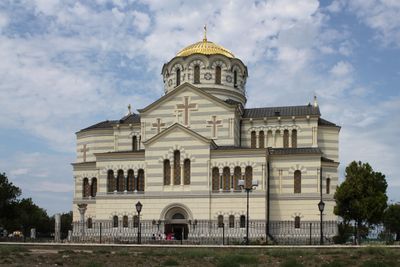
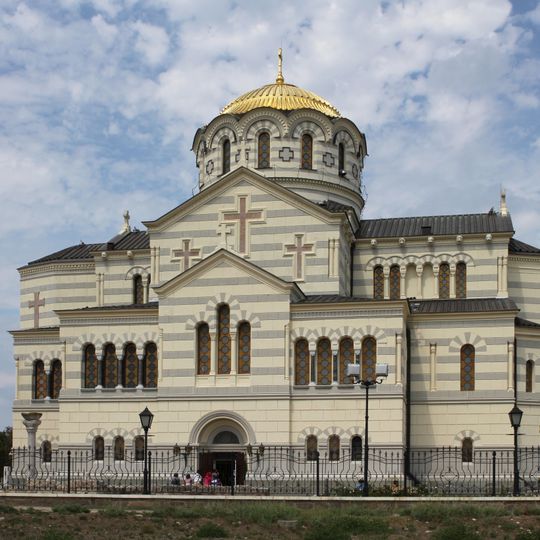
Chersonesus Cathedral is a brick Orthodox church in Sevastopol with alternating bands of cream and grey stone. Its facade has a triangular gable with a tall stone cross, flanked by two smaller crosses. A single drum with narrow arched windows rises to a ribbed golden dome and cross. The lower level has rows of arched windows and a central arched doorway reached by steps, with an iron fence at the base.
The cathedral was completed in 1891 under architect David Grimm's design. It was built at the location traditionally believed to be where Prince Vladimir received baptism around 987.
The lower church holds a marble reliquary shaped like a Gospel book, given in 1859 from the Winter Palace's small church and containing relics of Prince Vladimir; it stands beside the excavated ruins of an ancient basilica. The upper church's altar holds a copy of the Korsun Mother of God icon, which tradition says Vladimir brought from Chersonese. Relics of 115 saints were transferred to the cathedral.
The cathedral is open daily for visitors and worshippers, with guided tours available in several languages. Regular Orthodox services take place throughout the week, creating an active religious environment for guests.
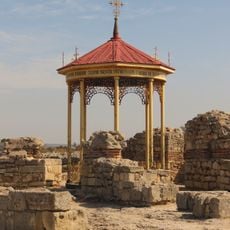
The 1827 excavations led by K. Kruse uncovered a cruciform church at the centre of the ancient market square, not a Greek temple. Historians Frédéric Dubois de Montpéreux and Nikolai Murzakevich later proposed this was the site of Vladimir's baptism. A reliquary in the form of a Gospel, sent from the Winter Palace in 1859, holds relics of the prince and was placed in the lower church beside those ruins.
The community of curious travelers
AroundUs brings together thousands of curated places, local tips, and hidden gems, enriched daily by 93,535 contributors worldwide.