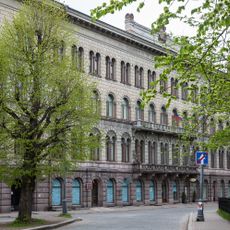
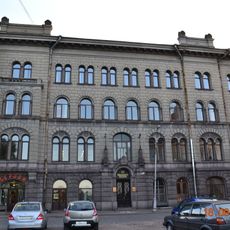
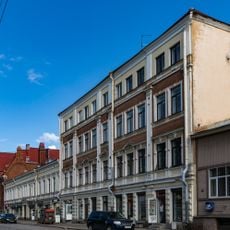
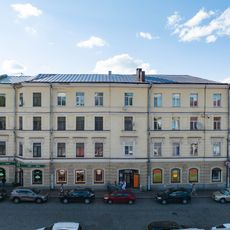
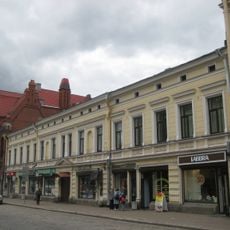
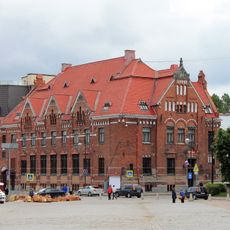
Vyborg market, Market hall in Vyborg, Russia.
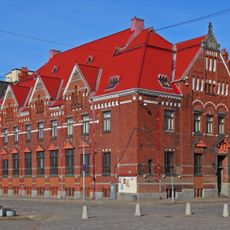
Vyborg market is a two-storey market hall of national Romantic style, built 1904–1905 to Karl Hård af Segerstad's design at the northwest corner of Market Square. Its main facade is about 20 m wide and its side facade over 130 m long, with a clock tower at the main entrance. The facade bears Vyborg's coat of arms framed by plant ornament.
A competition for the new hall was won by architect Karl Hård af Segerstad, who later designed Helsinki's Hakaniemi market hall. The building, opened in 1906, replaced the dismantled east wing of a guest courtyard begun under Giacomo Quarenghi's 1794 plan. It rose on the Market Square formed where the old town wall had stood, on the site of the former Lakamunda tower, and incorporated an 1880s two-storey trading block. Damaged in the war, it reopened only in 1957.
The building's name in Finnish, Viipurin kauppahalli, is still used alongside the Russian one. Since the 1950s restoration the interior has monumental ceramic tiles and white marble counters. Today the ground floor is given over to food sales, while the upper floor holds souvenirs, household goods and clothing.
The hall stands at Severny Val 2, on the northwest corner of the market square, where the main street's perspective ends at its facade. The two-storey building is about 20 m wide and over 130 m long, with the clock tower by the main entrance. Food stalls fill the ground floor; souvenirs, household goods and clothing are upstairs.
The clock tower regained its original tented roof only in 1976; during the postwar reconstruction four of the seven pointed gables on the long side facades were never rebuilt, which changed the building's outline. The main facade is about 20 m wide, the side facade more than 130 m.
The community of curious travelers
AroundUs brings together thousands of curated places, local tips, and hidden gems, enriched daily by 93,371 contributors worldwide.