Venngarn Castle, Baroque castle in Sigtuna Municipality, Sweden.
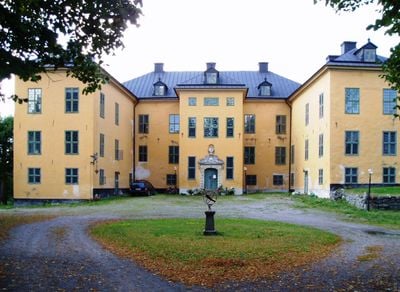
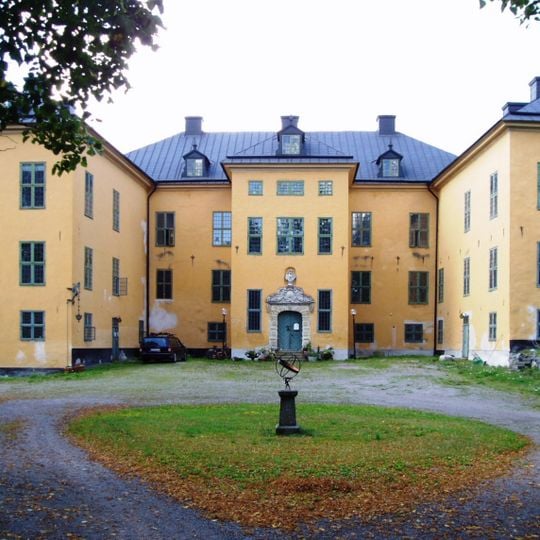
Venngarn Castle is a Baroque castle near Garnsviken, a couple of kilometres north of Sigtuna. Its three-storey ochre-yellow main block, flanked by two forward-projecting wings around a gravel courtyard, has a steep grey metal roof with a dormer and two chimneys. The symmetrical facade has rows of tall rectangular windows with pale frames and a stone entrance portal with a curved pediment.
A stone house stood here from the 1160s; in the late 16th century Duke Magnus II of Saxe-Lauenburg enlarged it into a Renaissance castle. In 1653 Magnus Gabriel De la Gardie bought the estate and had it rebuilt as a Baroque castle in 1670 with architect Jean de la Vallée. The crown confiscated it in 1681, and De la Gardie, ruined, lived there until his death in 1686.
The name Venngarn appears as Winagarnum in 1282 and ends in -garn, thought to mean something long and narrow in the terrain; the first element may be a dialect word for a woodland bird's mating ground. A medieval legend makes Venngarn the seat of the fictional Queen Disa, largely based on the older tale of Aslög.
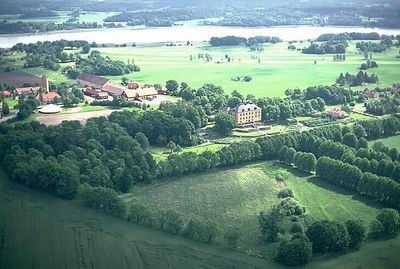
The castle stands by the shore of Garnsviken, a couple of kilometres north of Sigtuna, and is reached by road from there. Since 1997 it has operated as a health centre, so the buildings are not open to the public as a museum; visits depend on the current operator. The estate covers about 37 hectares, with the gravel courtyard between the two projecting wings as the arrival point.
The castle's name ends in -garn, which is thought to mean something long and narrow in the terrain, and the first element may be a dialect word for a woodland bird's mating ground. The estate appears as Winagarnum in a 1282 record and as Winagarn in the early 14th century.
The community of curious travelers
AroundUs brings together thousands of curated places, local tips, and hidden gems, enriched daily by 94,632 contributors worldwide.