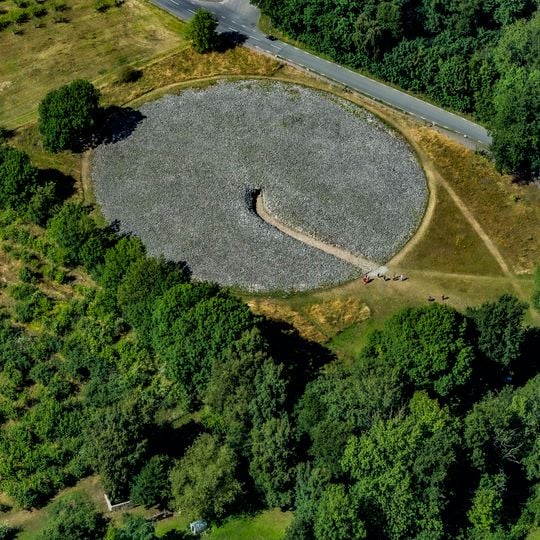
The King's Grave, Bronze Age burial site in Kivik, Sweden.
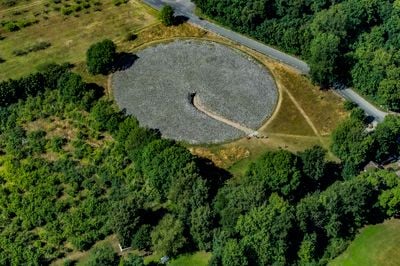
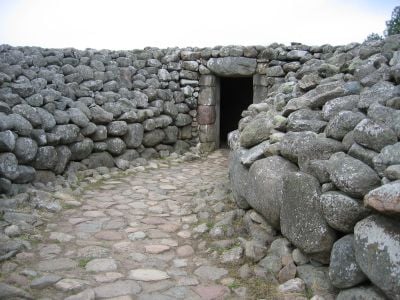
The King's Grave is a restored stone cairn near Kivik in Scania, Sweden, about 75 metres across and 3.5 metres high. At its centre lies a cist, a chamber 4 metres long and 1.5 metres wide, whose inner sides are ten upright slabs, eight carved with petroglyphs. A passage with a copper door leads inside.
On 14 June 1748, farmers Lasse Pärsson and Anders Sahlberg opened the burial chamber while removing stone for field walls. They were arrested for withholding treasure claimed by the Swedish state, and part of the trial was held at the cairn. They were released on 8 June 1749 for lack of evidence. The carvings were first recognised in 1756, and Gustaf Hallström excavated the monument in 1931.
The carved images inside show horses, birds, ships, and ritual scenes that reveal how Bronze Age people in Scandinavia understood their world and what mattered to them. These pictures on stone were their way of leaving messages about daily life and beliefs.
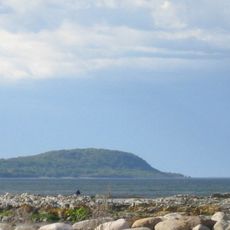
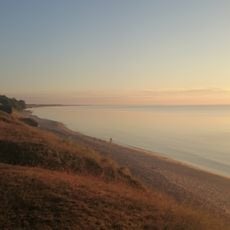
A passage built through the cairn in the 1932–1933 reconstruction leads to the decorated cist, which has a solid-copper door modelled on the Lion Gate at Mycenae. The restored mound stands about 3.5 metres high and 75 metres across; the original height is uncertain, with 20th-century estimates of 7 to 15 metres. The site lies near Kivik, roughly 320 metres from the Baltic coast.
Archaeologists found remains of an even older Stone Age settlement beneath the mound, with many flintstone pieces scattered around. These layers show that people lived at this spot across many thousands of years.
The community of curious travelers
AroundUs brings together thousands of curated places, local tips, and hidden gems, enriched daily by 93,379 contributors worldwide.