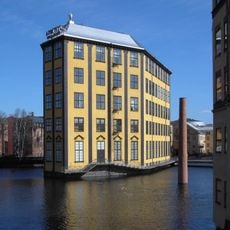
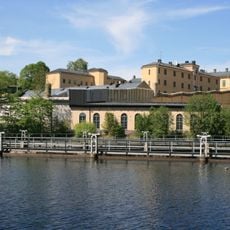
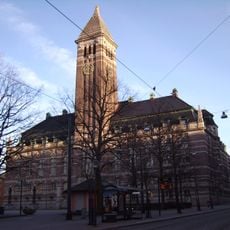
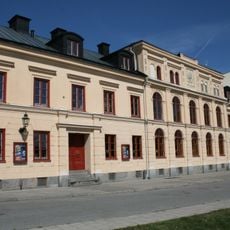
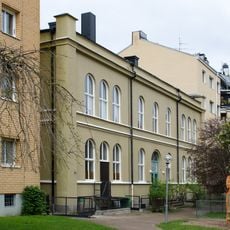
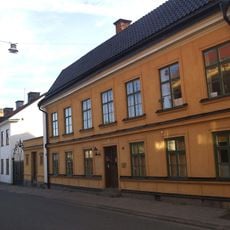
The Flat Iron, Industrial heritage building at Laxholmen in Norrköping, Sweden.
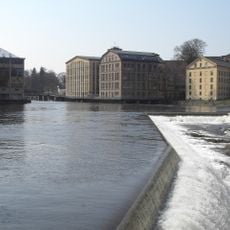
Strykjärnet is a seven-sided building of reinforced concrete in a Nordic classical style, designed by Folke Bensow and raised in 1916–1917 on the island of Laxholmen in the Motala ström. Its heptagonal plan follows the shape of the island, which gave the house its resemblance to a flat iron. The building is a listed monument since 1991.
Strykjärnet was built in 1916–1917 for Holmens Bruks och Fabriks AB and served as a weaving mill until 1934, after which twisting, winding and warping continued. Cotton production ended in 1964 and the last wool work in 1970. Since December 1991 the building has housed Arbetets museum, run as a private foundation.
The building houses a museum dedicated to labor history and industrial work in Sweden since 1991. Visitors can explore exhibits that document how people worked and lived during different periods of industrial production.
The building stands on Laxholmen island in the Motala River, reachable on foot from Norrköping's city centre. The Museum of Work occupies it, with its entrance on the island. The seven-sided plan means the narrowest point faces the current, so allow time to walk around the exterior.
The building is not triangular but heptagonal: seven sides follow the outline of Laxholmen island, so as much of the narrow site as possible could be built on. Small wooden structures stood on the island before the 1916–1917 construction. Sculptor Carl Milles called the area "the country's most beautiful industrial building".
The community of curious travelers
AroundUs brings together thousands of curated places, local tips, and hidden gems, enriched daily by 93,407 contributors worldwide.