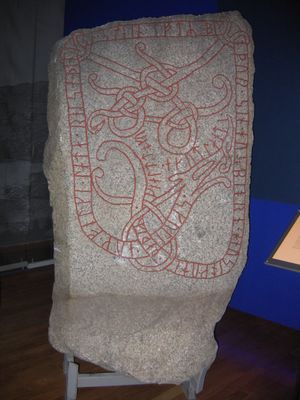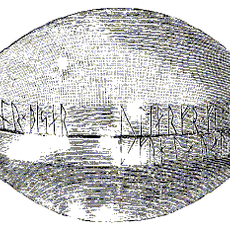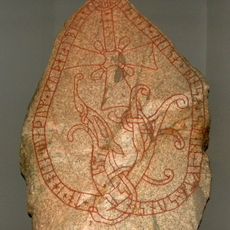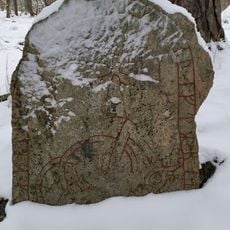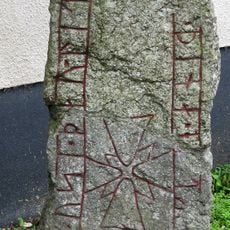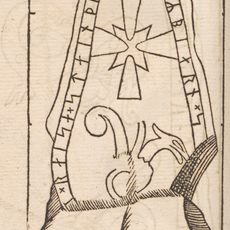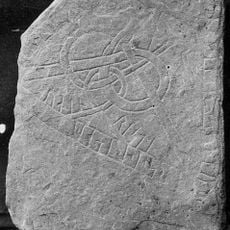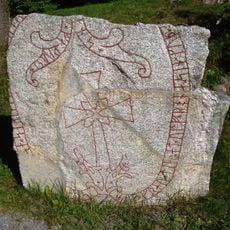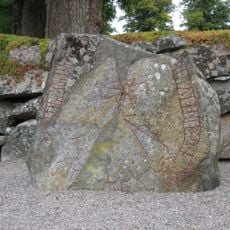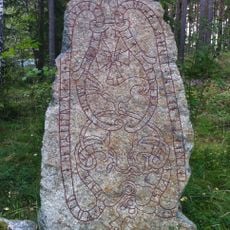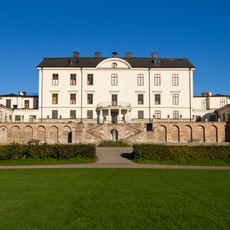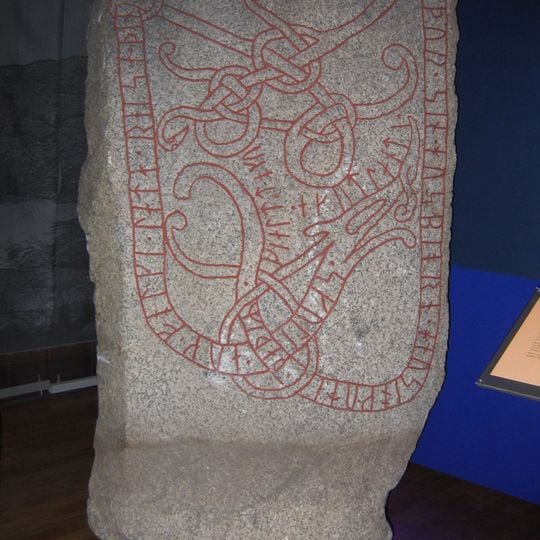
Uppland Runic Inscription 614, Norse runestone memorial in Torsätra, Sweden.
Uppland Runic Inscription 614 is a commemorative stone featuring runic carvings originally placed in Torsätra. The monument displays inscriptions in the Pr3 style with slender animal designs interwoven into compact patterns.
The inscription is unsigned but attributed to the runemaster Visäte, active in the second half of the 11th century, dating it to about 1060–1070. The stone was moved to the Swedish Museum of National Antiquities in 1967, not 2005 as sometimes stated. It was originally placed near U 613 in Torsätra.
The runes name the commissioners as Skuli and Folki, who raised the stone for their brother Húsbjǫrn (or Ásbjǫrn). Outside the serpent band runs the phrase "gjald tóku á Gotlandi", "they took payment on Gotland", the wording that makes the stone a witness to tribute taken from the island.
The stone is held at the Swedish History Museum in Stockholm, where it was moved in 1967 during archaeological excavation ahead of a military training field; the 2005 date refers to the excavation report. It is 145 cm tall, 100 cm wide and 30 cm thick, with rune heights of 5–7.5 cm and the carving painted in red. The runes face the southeast side.
The stone provides evidence of how Swedish royal administration operated and reveals that tax collection reached remote island territories. This makes it a rare source for understanding early medieval royal authority in Scandinavia.
The community of curious travelers
AroundUs brings together thousands of curated places, local tips, and hidden gems, enriched daily by 93,642 contributors worldwide.