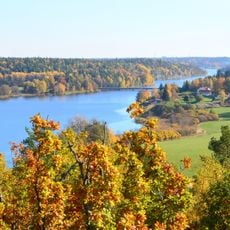
Balingsta gård, Manor house in Huddinge Municipality, Sweden
Balingsta gård is a former säteri by Lake Orlången in Huddinge socken. Its two-storey main building with a broken roof and two single-storey wings with the same roof type was built in the late 18th century and represents the late Gustavian style. The estate also comprises outbuildings, workers' housing, storehouses, farm buildings and torp.
Balingsta is first documented in 1436 as Balistadom. In the 1640s it became a säteri when the diplomat Johan Adler Salvius received it as a fief for his role in the negotiations that led to the Peace of Westphalia in 1648; the estate then included Vidja, Ågesta and Stuvsta. The present main building and two wings date from the late 18th century. From 1840 to 1940 the estate housed a school, and in 1918 the banker Albert Olof Nykopp had it restored by architect Evert Milles.
The name Balingsta likely comes from "Ballis stad", Ballis's farm, where Ballis means "dangerous, terrible, daring". The estate's mill, Balingsta kvarn, stands on the rock by Lake Orlången with remains of the mill cottage; it was abandoned in 1898 and restored with new wings in 1971. A water-powered skvaltkvarn used the outflow from Mörtsjön.
The surrounding land is managed by Huddinge Municipality, with farming operations continuing through lease agreements with local farmers. Visitors should expect the site to function as both a historical property and active farmland.
The old schoolhouse near Balingsta was in use from 1886 to 1919; only foundation remains survive today. Around 1900 it was Huddinge parish's largest school, with nearly 100 pupils taught by a single teacher, and crofters' children walked up to 16 km a day to reach it. Huddinge municipality has marked two of these routes as the Skolleden trails.
The community of curious travelers
AroundUs brings together thousands of curated places, local tips, and hidden gems, enriched daily by 93,911 contributors worldwide.