Ebba Brahes lusthus, 17th century manor pavilion in Bockhammar, Sweden
Ebba Brahe's Pavilion is a small light-pink octagonal building on a holm in the mill pond at Bockhammar farmstead. Its roof has a bell-cast profile and is covered with wooden shingles, and the weather vane bears the year 1636.
The pavilion stands on the bergsmansgård Bockhammar, an ironworks estate in Skinnskatteberg. Its weather vane bears the year 1636, four years after Gustav II Adolf's death at Lützen; if that is the construction year, it is Sweden's oldest preserved lusthus. After her husband Jakob De la Gardie died, Ebba Brahe continued to run all their estates, including Bockhammar.
The pavilion carries the name of Ebba Brahe, who grew up as a maid of honour at Tre Kronor in Stockholm, where she met the future Gustav II Adolf. After marrying Jakob De la Gardie she bore fourteen children, seven of whom died young, and ran the estates herself after his death, Bockhammar among them. In spring 2003 Posten issued a stamp series on summer houses that included this building.
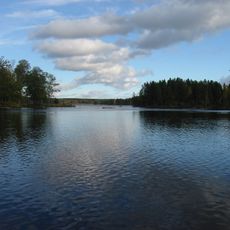
The pavilion stands on a holm in the Bockhammar mill pond, on the grounds of the Bockhammar bergsmansgård; reach it via the estate paths. It is part of Ekomuseum Bergslagen, whose sites are outdoors and visited on foot, so plan for walking and changeable weather rather than indoor opening hours.
The year 1636 is cut into the roof's weather vane, but the source only says that if this marks the building year, the pavilion would be Sweden's oldest preserved one. In 2003 the Swedish Post issued a stamp series on summer houses that reproduced Ebba Brahe's pavilion on one stamp.
The community of curious travelers
AroundUs brings together thousands of curated places, local tips, and hidden gems, enriched daily by 94,112 contributors worldwide.