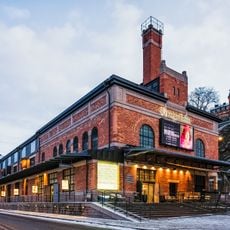
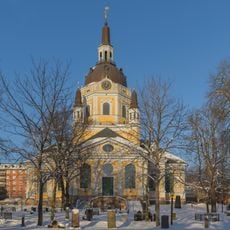
Katarinavägen, Street in Södermalm, Stockholm, Sweden
Katarinavägen is a street in Södermalm, central Stockholm, running along a steep slope from Slussplan southward. It connects different levels of the neighborhood through several staircases, including Harald Lindbergs stairs, and is characterized by early 20th century buildings that alternate with newer structures.
Katarinavägen was laid out after an 1890s city plan; construction began in 1900 and required blasting a road along the edge of Katarinaberget, cutting off Fjällgatan and Stigbergsgatan and removing small streets. A February 1908 Dagens Nyheter debate article protested that green slopes with wooden houses were replaced by a raw, sheer blasted rock face. The street opened to pedestrians on 28 October 1911 and to tram line IV on 1 February 1914, which ran until 3 September 1967.
The name, in use since 1900, comes from Katarinaberget, the hill whose edge the street follows. The street was long served by tram line IV, which ran here from 1 February 1914 until the right-hand traffic reform on 3 September 1967. Where it meets Renstiernas gata stands Stadsgårdshissen, a lift opened on 22 December 1907.
Katarinavägen runs from Slussbrogatan at Slussen east to Renstiernas gata and Fjällgatan. Three staircases lead down to Stadsgården: Borgmästartrappan, Lokattens trappor and Söderbergs trappor. Five staircases lead up to Klevgränd and Glasbruksgatan, including Thor Modéens trappor and Dihlströms trappor. Between Lokattens and Söderbergs trappor there is an open view north over Stadsgården and Stockholm's inlet.
A war monument called La Mano by artist Liss Eriksson stands beside the Dihlström staircase, honoring 170 Swedish volunteers who died in the Spanish Civil War in 1936. Next to it is a stone map showing the fighting locations in Spain, marking this historical solidarity.
The community of curious travelers
AroundUs brings together thousands of curated places, local tips, and hidden gems, enriched daily by 94,704 contributors worldwide.