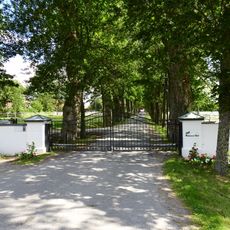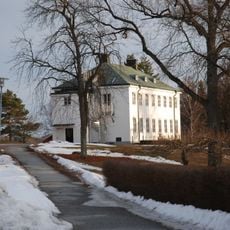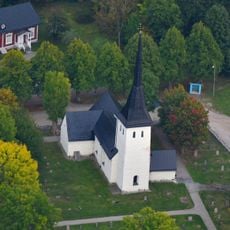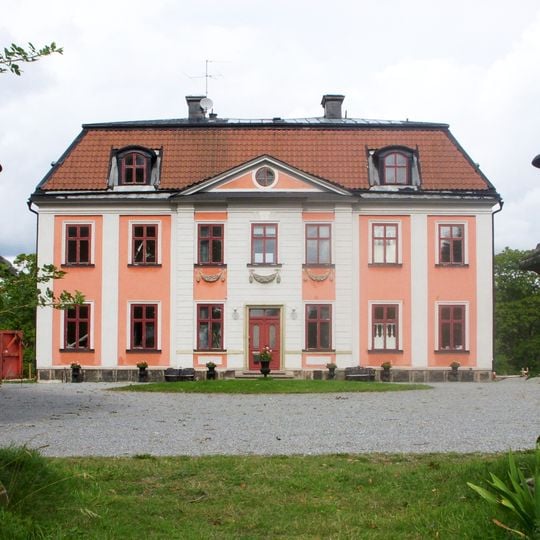
Kärsö gård, Manor house in Ekerö Municipality, Sweden.
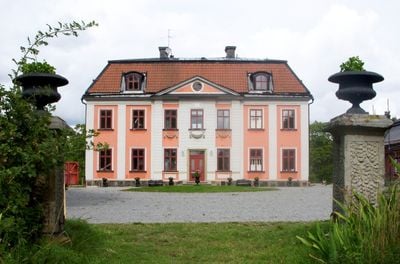
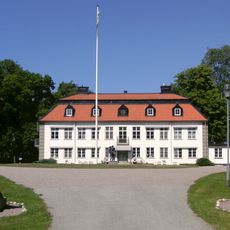
Kärsö gård is a manor house on a peninsula in Långtarmen in Mälaren. The main building is a plastered stone house of two storeys under a hipped roof, its pale peach-orange facade divided by grey-white pilasters and a white central section with a triangular pediment. Two detached wings flank it to the southwest, and an English park with a round lake and late 19th-century gazebo, dove house and bathhouse extends to the north.
Kärsö gård is first mentioned in 1287, when Bishop Bengt Birgersson owned it; in 1288 he donated it to Klara convent in Stockholm. The crown took over at the Reformation, and in 1627 Johan Skytte brought the five-farm village into noble hands. Joel Gripenstierna made it a säteri in the 1670s. The main building burned in 1755 and was rebuilt two years later, keeping much of its facade.
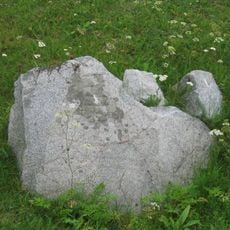
The name Kärsö appears in records as early as 1287, when Bishop Bengt Birgersson owned the estate. In the park north of the house, a three-metre granite memorial stone honours Carl Kjellberg, who bought the estate in 1904; it bears a bronze relief of him by sculptor Carl Fagerberg. The stone stands on a promontory by Långtarmen.
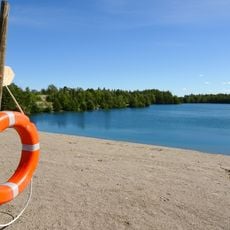
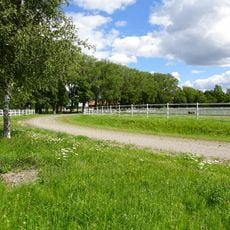
The manor stands on a peninsula of Kärsön by Långtarmen in Mälaren, in Ekerö Municipality. The English park north of the main building was laid out around a round lake, a water-filled kettle hole from the last ice age. A three-metre granite memorial stone with a bronze relief of Carl Kjellberg stands on a point by Långtarmen.
The three-metre granite memorial on the point by Långtarmen honours Carl Kjellberg, who bought Kersö in 1904; a bronze relief by sculptor Carl Fagerberg shows his portrait above the inscription. The English park north of the house was laid out around a round lake, a water-filled kettle hole left by the last ice age.
The community of curious travelers
AroundUs brings together thousands of curated places, local tips, and hidden gems, enriched daily by 95,099 contributors worldwide.