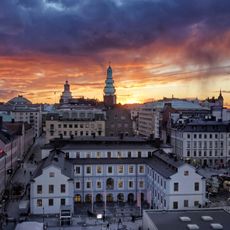
Ormsaltaren, Historical architectural structure in Södermalm, Stockholm, Sweden
Ormsaltaren is a stone structure at Klevgränd 1C in Södermalm with significant cultural value among the historic buildings of the district. The building sits within a group of older structures and can be reached via Thor Modéns stairs.
The building dates from the early 1600s and is the oldest preserved secular structure in Södermalm. Its presence here shows how the neighborhood developed during Stockholm's earliest periods of urban growth.
The name Ormsaltaren has two explanations: Stockholm's street-name book calls "ormsaltare" a dialect word for a sly person, while Björn Hasselblad traces it to the German immigrant Alexander Ormesälter, who owned a house here in the late 1600s and ran a "lyckopotta", a forerunner of the raffle. Petrus Tillaeus's 1733 map already shows Ormsaltergränd for today's Klevgränd.
The quarter is bounded by Mariagränd to the north, Götgatan to the west and Klevgränd to the south. The stone house at Klevgränd 1C stands by Thor Modéns stairs, reached on foot through narrow lanes. The Stomatol sign faces north on Klevgränd 1B.
The Stomatol sign has hung on the north facade of Klevgränd 1B since 1933, a landmark of the Södermalm skyline. The corner house at Klevgränd 1A/Götgatan 7, designed by Wilhelm Klemming and built in 1911–1912, is noted for its planted roof terrace.
The community of curious travelers
AroundUs brings together thousands of curated places, local tips, and hidden gems, enriched daily by 94,119 contributors worldwide.