Stomatol Sign, Illuminated advertising sign in Slussen district, Stockholm, Sweden
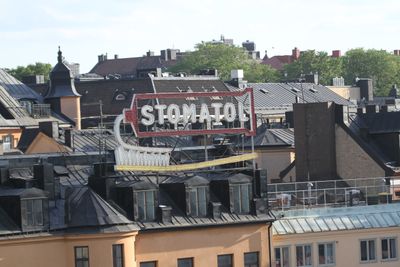
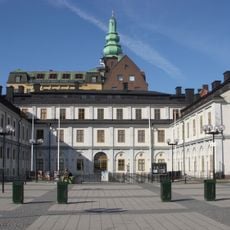
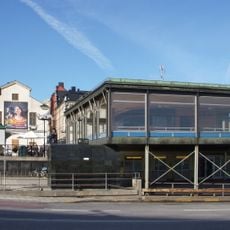
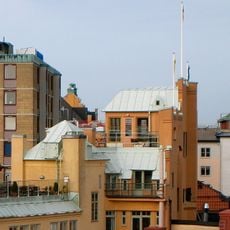
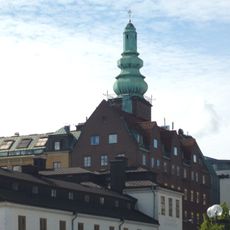
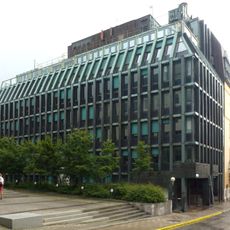
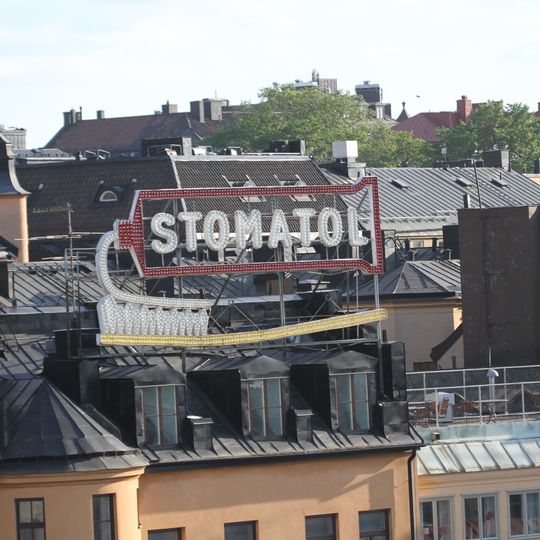
The Stomatol Sign is a rooftop light display above the Seamen's Home building at Klevgränd 1B on Södermalm, made of 1,361 coloured 25 W bulbs in red, yellow and white. It shows a toothpaste tube and a toothbrush, and the bulbs light in sequence so the paste appears to flow from tube to brush.
Inventor and artist Mauritz Larsson built the sign using his direct-current switches, and it was mounted on 22 November 1909 on the old Katarina Elevator for the soap firm Grumme & Son. When that elevator was demolished in 1933, the sign moved to the roof of Klevgränd 1B. It went dark during both world wars and again from 1963 to 1972 and 1981 to 1986, when Cederroth funded its restoration.
The sign's name comes from the toothpaste brand Stomatol, made by the soap works Grumme & Son, which commissioned it in 1909. The animated sequence begins with a red frame around the tube, then the letters of "STOMATOL" light one by one, followed by the toothbrush and a flow of toothpaste. The sign appears in the film adaptation of Stieg Trenter's novel I dag röd and in the TV series Myggan.
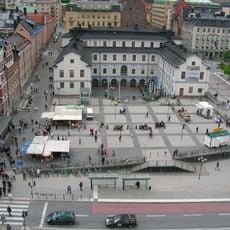
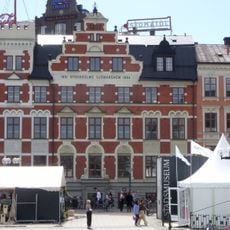
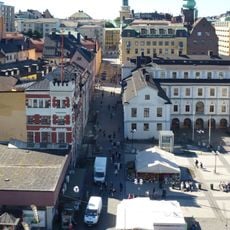
The sign can be viewed from multiple locations near Slussen subway station, with Kornhamnstorg offering a particularly good vantage point. The illumination is clearest after dark, so visiting after sunset gives the best view.
The lights follow a sequence that simulates squeezing toothpaste onto a brush by lighting up one after another. This clever bulb trick created the illusion of movement long before digital screens existed.
The community of curious travelers
AroundUs brings together thousands of curated places, local tips, and hidden gems, enriched daily by 93,786 contributors worldwide.