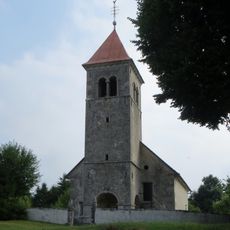
Betalov spodmol, Archaeological site near Postojna, Slovenia
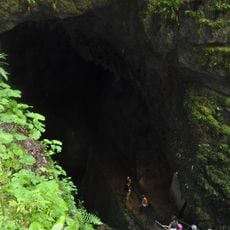
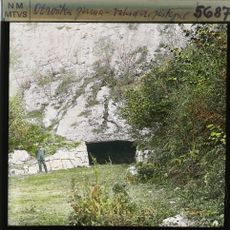
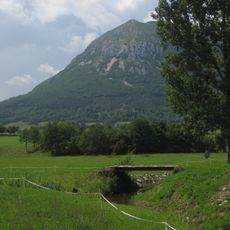
Betalov spodmol is a karst rock shelter on the slope above the Postojna–Bukovje road, about 2 km northwest of Postojna. Its entrance formed when the ceiling of a 174 m cave carved by the Pivka River collapsed. Excavations exposed a profile over 10 m deep with eight cultural horizons; five strata yielded stone tools and bones of more than 2,400 animals.
Franco Anelli excavated the site between 1933 and 1939, uncovering Palaeolithic artefacts and faunal remains, though most of his work remained unpublished and his records were later lost. Srečko Brodar resumed systematic recording from 1947 to 1953, documenting a profile over 10 metres deep with eight cultural horizons. The oldest layers, attributed to the Mindel-Riss interglacial, yielded proto-Mousterian tools and Deninger's bear bones dated to about 300,000 years ago. The site was declared a monument of local importance on 22 December 1984.
The name Betalov spodmol is Slovene for "Betal's hollow," and the site lies about 2 km northwest of Postojna, just above the Postojna–Bukovje road. It is one of Slovenia's three most important Palaeolithic cave sites, alongside Divje babe I and Potočka zijalka. Since 22 December 1984 it has been protected as a monument of local importance, registered under number 859.
The shelter sits on a slope directly above the Postojna–Bukovje road, about 2 km northwest of Postojna, and is reached on foot from the roadside. The entrance is a collapsed ceiling opening, not a developed show cave, so there are no walkways, lighting or railings. The excavated profile is over 10 m deep and the deposits are protected as a monument of local importance, so the sections should be viewed without touching or climbing them.
The 10-metre profile holds eight cultural horizons; five separate strata yielded bones of over 2,400 animals alongside stone tools. The oldest layer, about 300,000 years old, contained proto-Mousterian tools and bones of a Deninger's bear. Franco Anelli's 1933–1939 excavation records were later lost, so much of his Late Pleistocene material can no longer be placed in stratigraphic context.
The community of curious travelers
AroundUs brings together thousands of curated places, local tips, and hidden gems, enriched daily by 94,195 contributors worldwide.