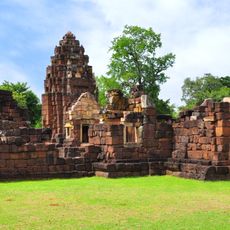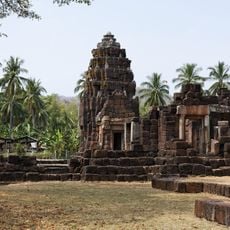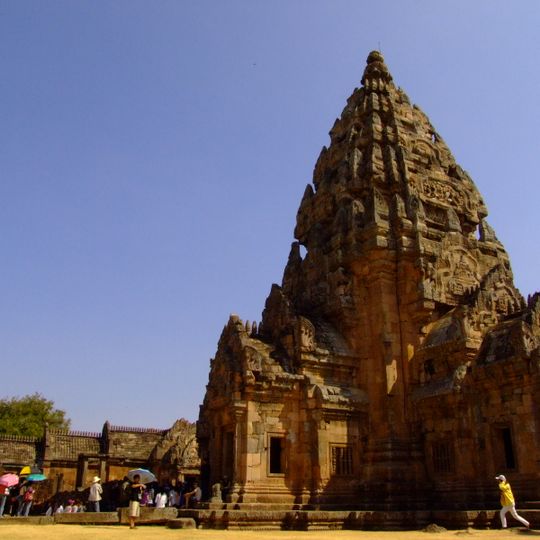
Phanom Rung historical park, Hindu temple complex in Buriram Province, Thailand
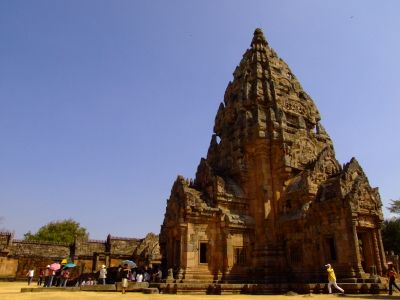
Phanom Rung is a Hindu temple complex in Buriram Province that sits atop an extinct volcano and connects to the main sanctuary through a long processional walkway. The entire site is built from pink sandstone and laterite, with intricate carvings on door frames, lintels and walls.
Construction began in the 10th century under the Khmer Empire and continued until the 13th century, with different rulers adding new buildings. The complex was originally dedicated to the Hindu god Shiva and served as a religious center for the region.
The name derives from the Khmer word ភ្នំរុង (phnom rung), meaning "large mountain". The temple was a Shaivite sanctuary, and its layout stands for Mount Kailash, Shiva's dwelling; the inner sanctum once held the linga, of which only the somasutra drainage channel remains. The site is now a historical park under the Fine Arts Department and was submitted to UNESCO in 2005.
The site lies about 77 km south of Buriram city in Ta Pek subdistrict. From the lower stairway, a 160-metre walkway paved with laterite blocks and lined with 70 sandstone posts leads to the first naga bridge; the climb then continues by stairs in five terraced sets to the inner sanctuary.
The alignment of the complex follows a precise astronomical calculation, allowing sunlight to pass through all 15 doorways on certain days in April and September. This effect demonstrates the advanced knowledge of Khmer architects about celestial movements and their ability to embed religious symbolism into structures.
The community of curious travelers
AroundUs brings together thousands of curated places, local tips, and hidden gems, enriched daily by 92,322 contributors worldwide.