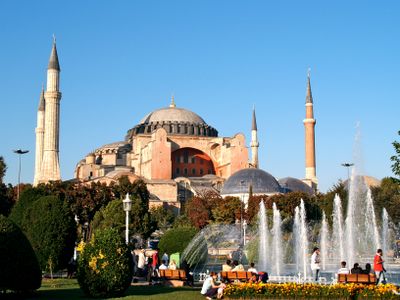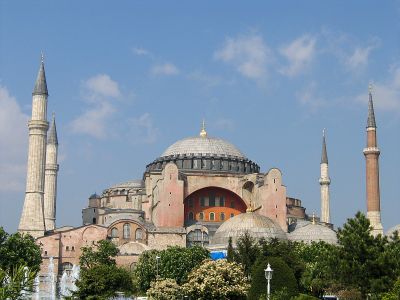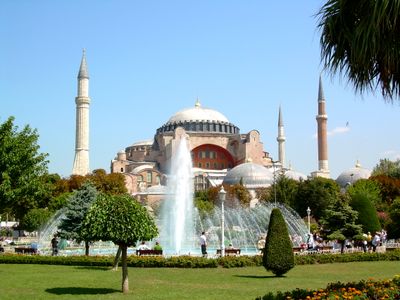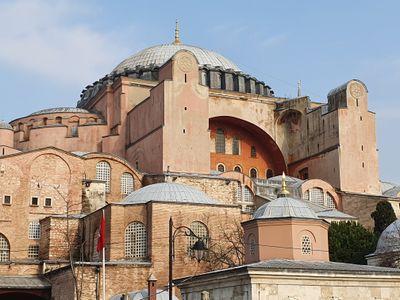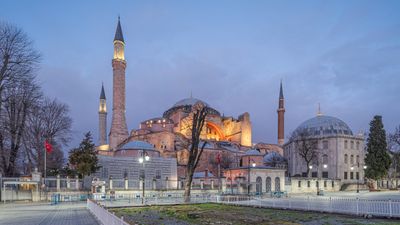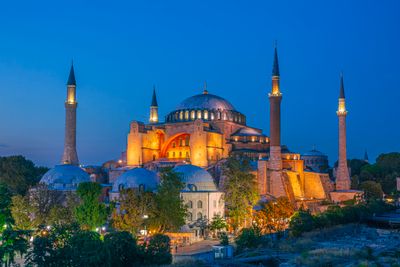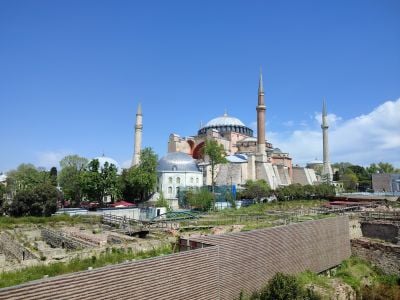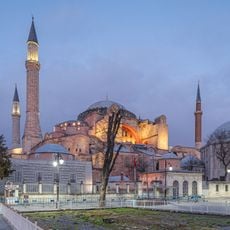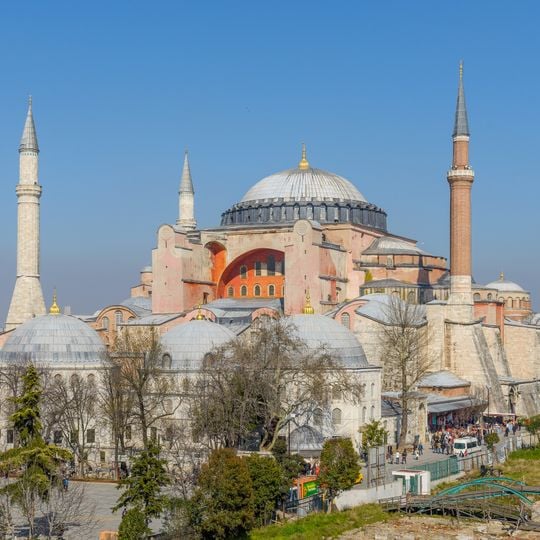
Hagia Sophia, Byzantine mosque in Sultanahmet, Turkey
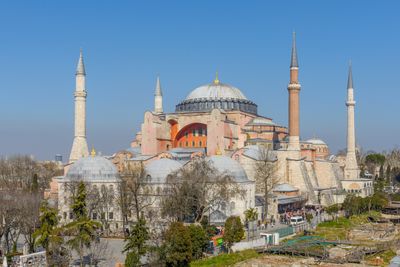
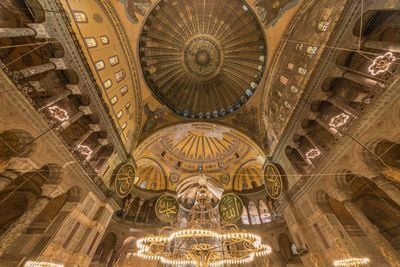
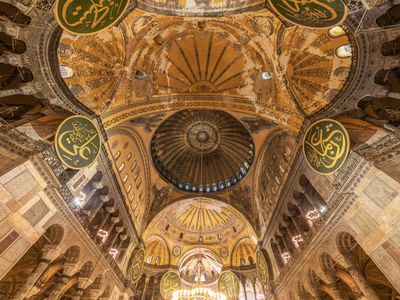
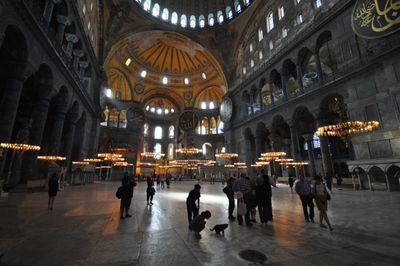
The central dome reaches 56 meters (184 feet) above the marble floor and rests on pendentives with half-domes arranged in tiers. The interior measures 82 meters (269 feet) long and 73 meters (240 feet) wide, forming a wide nave bounded by heavy piers, while golden mosaics cover much of the upper walls and vaults and large Ottoman roundels with Arabic calligraphy hang from the main supports.
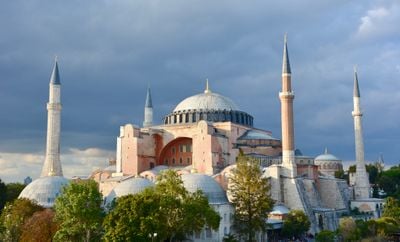
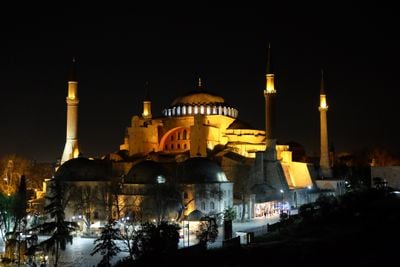
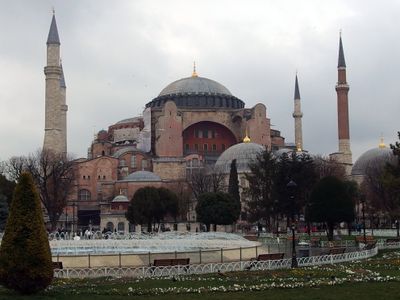
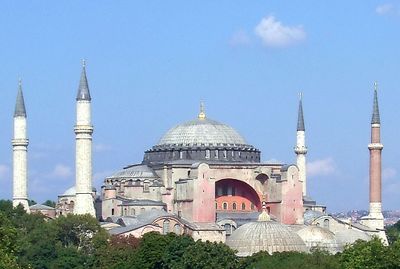
Justinian I ordered the third structure in 532 after earlier versions were lost to fire and riots, and the architects finished the work within five years by 537. Sultan Mehmed II converted the church to a mosque in 1453 following the conquest of Constantinople and added minarets, while later Ottoman rulers brought further Islamic elements before the building became a museum in 1935 and returned to mosque status in 2020.
Worshippers gather for daily prayers while visitors come to see how Christian mosaics and Islamic calligraphy share the same walls. The space functions today as a working mosque where the carpet-covered floor and the call to prayer remind everyone that religious life continues alongside the building's role as a monument to two faiths.
Visitors must cover shoulders and knees, and women need a headscarf during prayer times. Queues can stretch for several hours, especially on weekends and holidays, while the T1 tram stops at Sultanahmet station within walking distance and photography is allowed outside prayer times without flash.
The structure preserves its original construction from the 6th century with 40 windows around the dome base that create a floating light effect. The architects used lighter tuff bricks from Rhodes in the upper dome section to reduce weight and embedded acoustic amphorae in walls and vaults to amplify sound and lessen the structural load.
Location: Fatih
Location: Istanbul
Location: Istanbul Province
Location: Cankurtaran
Inception: December 27, 0537
Founders: Constantine the Great
Architects: Isidore of Miletus, Anthemius of Tralles, Trdat the Architect, Mimar Sinan
Official opening: 1054
Architectural style: Byzantine architecture, basilica
Accessibility: Wheelchair accessible
Part of: Historic Areas of Istanbul
Address: Soğukçeşme Sokağı
Phone: +902125221750
Email: contact@muze.gen.tr
Website: https://youtu.be/w-cyVWCbGXo
GPS coordinates: 41.00833,28.98000
Latest update: December 2, 2025 20:39
This collection presents significant architectural works from different periods and continents. From medieval cathedrals to contemporary skyscrapers, the selection documents the technical and aesthetic development of building design. The listed buildings were created by influential architects and have shaped the evolution of modern architecture. The list includes religious structures such as Gothic churches and monasteries, public facilities like museums and concert halls, and residential buildings that established new construction standards. Each building demonstrates particular structural solutions or stylistic features that contribute to understanding architectural history. The selection offers insights into various building styles, materials and construction methods.
This collection brings together notable domes and cupolas from all continents, signs of diverse architectural traditions extending from the Vatican to Australia, Russia to the United Arab Emirates. From the famous dome of St. Peter's Basilica in Rome to the colorful domes of the Church of the Savior on Spilled Blood in Saint Petersburg, the Renaissance dome of Florence Cathedral, to the cast-iron dome of the US Capitol in Washington, each structure tells a particular story and reflects the ambitions of its era. These buildings span several centuries of architectural innovation and serve various functions: religious structures like the Sheikh Zayed Grand Mosque or the Basilica of Our Lady of Peace in Côte d'Ivoire, civil buildings such as Oxford's Radcliffe Camera or the Australian Exhibition Palace, and even thermal spas like Budapest’s Széchenyi Baths. Each dome illustrates construction techniques and aesthetic decisions specific to its culture, offering insight into skills that enabled the creation of these monumental coverings.
This collection encompasses ancient stone monuments and sacred sites from across the globe, ranging from the Easter Island Moai to the Great Wall of China. The structures represent millennia of human engineering and include religious temples, fortifications, burial sites, and astronomical installations. Many of these locations retain cultural significance for local communities today. Examples include prehistoric sites such as Göbekli Tepe in Turkey and Skara Brae in the Orkney Islands, alongside monumental constructions like the Parthenon in Athens, Angkor Wat in Cambodia, and the Pyramids of Giza in Egypt. The collection also features lesser known treasures including the Megalithic Temples of Malta, Nan Madol in Micronesia, and Great Zimbabwe. These sites provide insight into ancient cultures, religious practices, and architectural achievements that continue to draw visitors from around the world.
Circular architecture has fascinated builders since ancient times. This collection brings together Roman amphitheatres like the Colosseum, medieval towers such as the Round Tower in Copenhagen, baroque domed structures and modern constructions. The circular form offers practical advantages for acoustic properties, structural stability and optimal space usage. The selected buildings serve various functions: religious temples, fortifications, observatories, museums and event venues. Each example demonstrates how architects have adapted the circular form to local conditions and cultural requirements. From ancient stone structures to contemporary skyscrapers, this selection documents technical evolution across centuries.
Stone mosaics adorn buildings across continents, offering insights into the artistic traditions of different eras. Roman floor mosaics feature mythological scenes and geometric patterns in villas and public baths. Byzantine wall mosaics in churches depict religious figures using gold tesserae, while Islamic mosaics in mosques and palaces showcase intricate geometric and floral compositions. Examples of this art form can be found at Hagia Sophia in Istanbul, where Christian and Islamic elements coexist, in the early Christian basilicas of Ravenna with their detailed biblical narratives, and at the Dome of the Rock in Jerusalem with its elaborate arabesques. Modern interpretations appear in subway stations, public squares, and contemporary buildings, demonstrating the continued relevance of this technique.
Istanbul offers photographers an uncommon range of subjects, combining architecture from multiple centuries with urban landscapes and waterways. This route includes Byzantine and Ottoman monuments such as Hagia Sophia and Topkapi Palace, along with the Galata Tower that has stood over the old city since the 14th century. The Bosphorus separates Europe and Asia and provides the setting for historic sites including Rumeli Fortress, Maiden's Tower, and waterfront palaces like Dolmabahce Palace and Kucuksu Palace. The route passes through districts with different character. Balat displays Ottoman wooden houses and narrow lanes, while Karakoy is known for its renovated industrial buildings. The Princes' Islands off the coast offer car-free streets and neoclassical mansions. Viewpoints like Camlica Hill and Pierre Loti Hill provide panoramic views of the city and the Sea of Marmara. Additional destinations include Suleymaniye Mosque, Emirgan Park with its tulip beds, and modern structures like Zorlu Center.
In 2007, the New Seven Wonders Foundation, led by Swiss businessman Bernard Weber in cooperation with the marketing company Deureka, organized a global vote, the results of which were announced on July 7 in Lisbon. This project, which was especially successful in India and China, enabled the designation of seven monuments representing different civilizations and eras, from antiquity to the 20th century. UNESCO stated in a release that it was not involved in this event, contrary to what many voters believed. The final selection includes sites across all continents: the Great Wall of China, a fortification system built over several centuries; Petra in Jordan, a Nabataean city from the 4th century BC carved into rose-colored rock; the Colosseum in Rome, a 1st-century amphitheater capable of holding 50,000 spectators; Chichen Itza in Mexico, a Maya site demonstrating the astronomical knowledge of this civilization; Machu Picchu in Peru, an Inca city from the 15th century located at 2,430 meters above sea level; the Taj Mahal in India, a white marble mausoleum built between 1631 and 1643; and the Christ Rédempteur statue in Rio de Janeiro, a 38-meter-tall monument inaugurated in 1931. The Khufu pyramid, the only remaining ancient wonder still standing, was removed from the voting list and designated an honorary wonder. The 21 candidate sites were selected by a commission of architects from five continents, chaired by Federico Mayor, former UNESCO Director-General. The criteria included aesthetics, architectural achievement, and historical significance. Each monument had to be constructed by humans, completed before 2000, and in acceptable preservation condition. This collection lists all monuments and allows users to view their locations and photos via individual records.
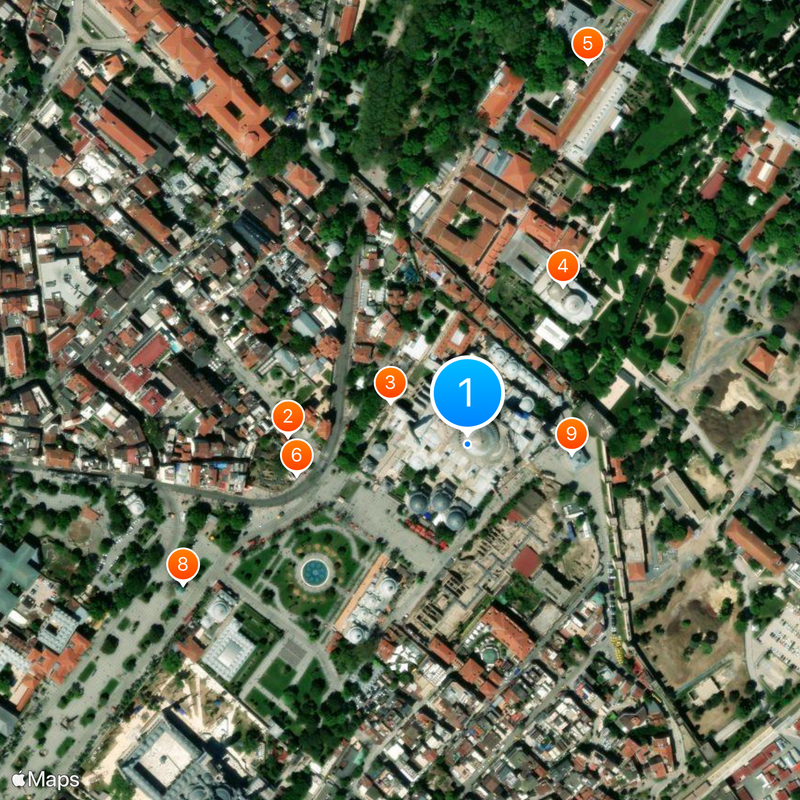
Sultan Ahmed Mosque
431 m
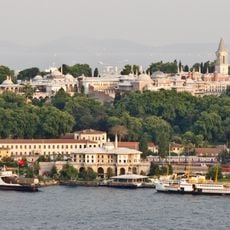
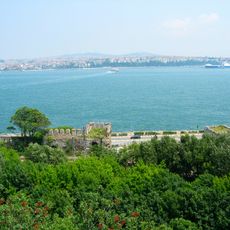
Topkapı Palace
430 m
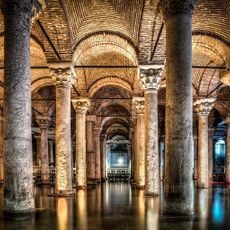
Basilica Cistern
175 m
Runic inscriptions in Hagia Sophia
86 m
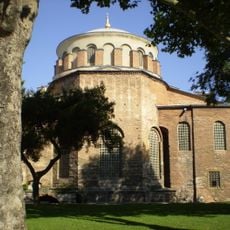
Hagia Irene
180 m
Obelisk of Theodosius
470 m
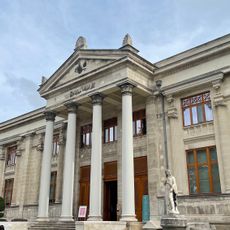
Istanbul Archaeology Museums
389 m
Gülhane Park
433 m
Hippodrome of Constantinople
432 m
The Stone of Million
169 m
Historic Areas of Istanbul
16 m
Turkish and Islamic Arts Museum
507 m
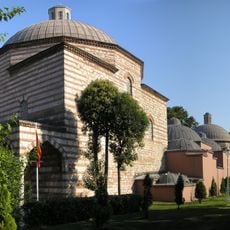
Haseki Hürrem Sultan Hamamı
412 m
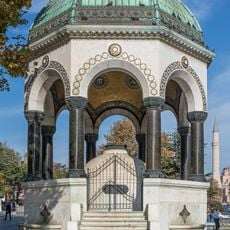
German Fountain
321 m
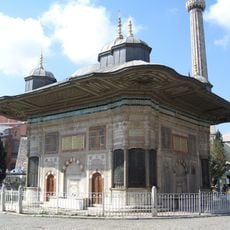
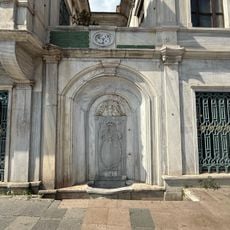
Fountain of Ahmed III
102 m
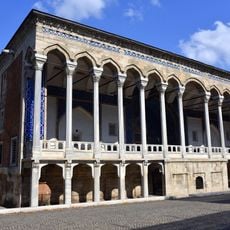
Tiled Kiosk
424 m
Church of the Virgin of the Pharos
363 m
Hodegon Monastery
430 m
Zeynep Sultan Mosque
173 m
Ahmet Hamdi Tanpınar Literature Museum Library
329 m
Procession Kiosk
342 m
Ahırkapı Feneri
508 m
Cağaloğlu Hamam
448 m
Firuz Ağa Mosque
319 m
Hazine-i Evrak binası
398 m
Istanbul Governor's Office
518 m
Cezeri Kasım Pasha Mosque
514 m
Hagia Sophia History and Experience Museum
442 mReviews
Visited this place? Tap the stars to rate it and share your experience / photos with the community! Try now! You can cancel it anytime.
Discover hidden gems everywhere you go!
From secret cafés to breathtaking viewpoints, skip the crowded tourist spots and find places that match your style. Our app makes it easy with voice search, smart filtering, route optimization, and insider tips from travelers worldwide. Download now for the complete mobile experience.
A unique approach to discovering new places❞
— Le Figaro
All the places worth exploring❞
— France Info
A tailor-made excursion in just a few clicks❞
— 20 Minutes