Stepan Bandera monument in Lviv, Bronze and granite monument in Lviv, Ukraine
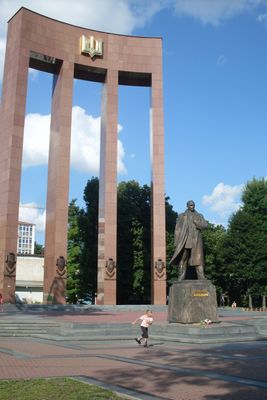
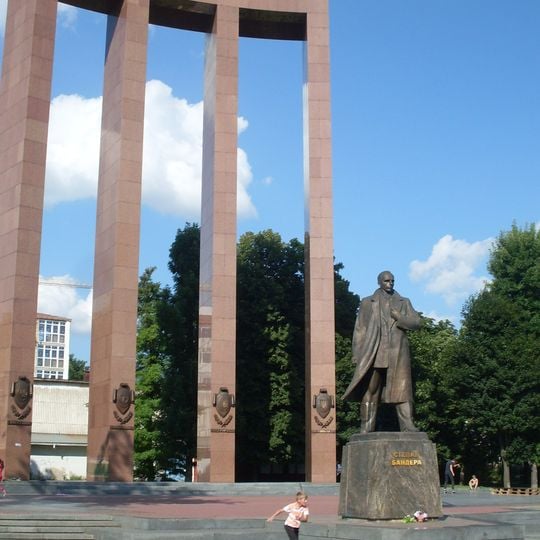
The Stepan Bandera monument in Lviv stands on Kropyvnytskyi Square: a bronze figure of Bandera in a long coat, one hand at his chest, on a dark granite pedestal inscribed in gold Cyrillic letters. Behind it rises the 30-metre Stele of Ukrainian Statehood, an arch on four pinkish-brown columns, each standing for a period of Ukrainian statehood; the whole complex is 7 metres tall.
The memorial was unveiled on October 13, 2007, and came into being after years of discussion about public monuments in Ukraine. Its construction sparked debates about memory and commemoration that continue today.
Bandera led the OUN-B faction, and the monument became a focal point of the memory conflict after 1991: Russian media stressed the UPA's ties to Nazi Germany, while critics cite the UPA's role in the killing of 100,000 Poles in Volhynia and Eastern Galicia. On 30 June 1941, shortly after Lviv fell under Nazi control, the OUN-B proclaimed an independent Ukrainian state in the city.
The monument stands on Kropyvnytskyi Square, in front of the 30-metre Stele of Ukrainian Statehood with its four columns. The statue faces the stele, so the square is crossed on foot to see both parts of the complex together. The paving and the low step in front of the pedestal are level ground.
The four columns of the Stele of Ukrainian Statehood behind the statue each stand for a period of Ukrainian statehood: Kievan Rus', the Cossack Hetmanate, the Ukrainian People's Republic, and independent Ukraine. The statue itself was unveiled alone in 2007, because a shortage of funds meant only the figure was ready for the 65th anniversary of the UPA.
The community of curious travelers
AroundUs brings together thousands of curated places, local tips, and hidden gems, enriched daily by 93,469 contributors worldwide.