Statue of the Duc de Richelieu in Odesa, Bronze statue at Prymorskyi Boulevard, Odesa, Ukraine
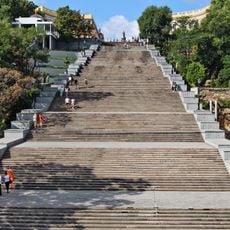
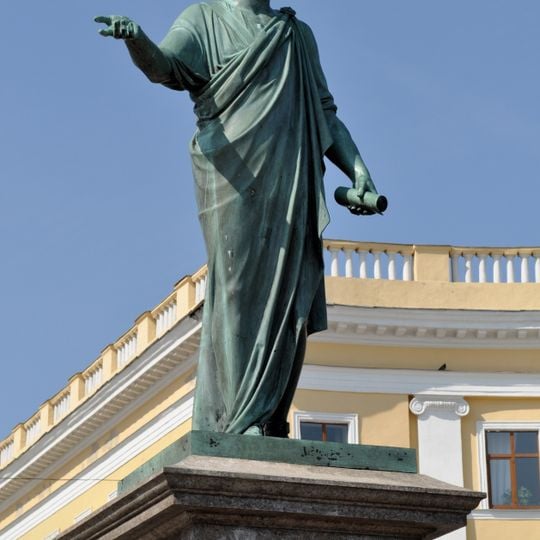
The Statue of the Duc de Richelieu is a bronze figure in a Roman toga holding a scroll, standing on a square pedestal of pink polished granite from the Southern Bug River. The pedestal rests on a limestone stylobate with four granite steps. The statue faces the sea at the top of the Potemkin Stairs, with a yellow building and white balustrade behind it.
Count Langeron called for public donations after Richelieu's death in 1822, and Governor-General Mikhail Vorontsov commissioned Ivan Martos, for whom this became one of his last works. The foundation was laid on 30 June 1827; Vasily Yekimov cast the bronze in St. Petersburg, and Francesco Boffo supervised the installation. The monument was unveiled on 22 April 1828. A cannonball splinter damaged the pedestal during the Crimean War, and a cast-iron patch with a stylized cannonball marks the spot.
Odesa residents called Richelieu "our Duke" and still treat the statue as the city's founding figure, though Odesa was already eight years old when he arrived. A local saying tells you to look at the Duke from the second manhole cover, where the scroll and robe folds form a suggestive shape. The bronze relief of Justice on the pedestal is shown without her usual blindfold.
The statue stands on Prymorskyi Boulevard directly above the Potemkin Stairs and is freely accessible throughout the day. From this spot you get a wide view over the Black Sea and the port facilities below the cliff.
The bronze figure was the first public monument in the city and was designed by Avraam Melnikov and Francesco Boffo. The classical depiction in Roman toga was unusual at the time for a French aristocrat and 19th-century politician.
The community of curious travelers
AroundUs brings together thousands of curated places, local tips, and hidden gems, enriched daily by 94,299 contributors worldwide.