Chicago Water Tower, Historic water tower in Chicago, United States.
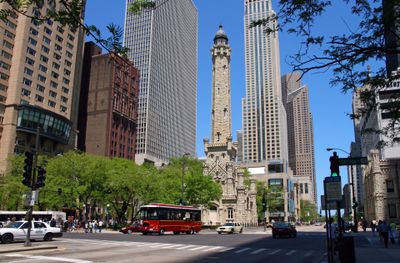
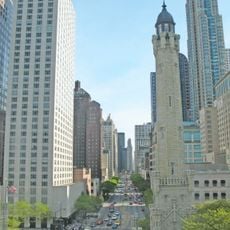
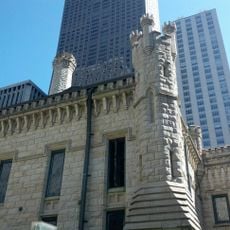
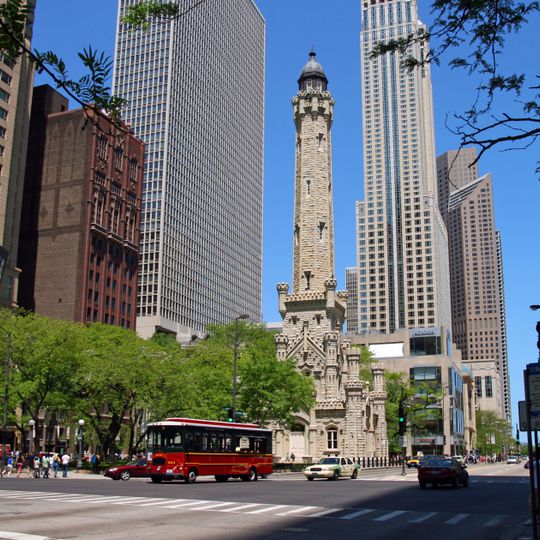
The Chicago Water Tower is a 182.5-foot (56 m) tower of yellowing Lemont limestone at 806 North Michigan Avenue, designed in 1869 by William W. Boyington in Gothic Revival style. Its square lower shaft has a projecting central bay with a pointed-arch window and slit windows above, corner buttresses with finials, and a crenellated parapet with corner turrets. An octagonal shaft with a steep conical roof rises from the base.
Designed in 1869 by William W. Boyington and built from yellowing Lemont limestone, the tower enclosed a 138-foot standpipe that regulated pressure for the city's water system. During the Great Chicago Fire of 1871 its roof burned and the adjacent pumping station stopped, yet the tower stood as the only public building in the burned zone to survive. Afterward it briefly stored books donated by Queen Victoria to replace the burnt library.
The tower's name passed to Water Tower Place, the 1975 mixed-use skyscraper beside it. Since 2014 the surrounding park has been Jane M. Byrne Plaza, named for Chicago's first woman mayor. Inside, the City Gallery in the Historic Water Tower shows work by local photographers, artists and filmmakers.
The tower stands at 806 North Michigan Avenue in Jane M. Byrne Plaza, across from the Chicago Avenue Pumping Station. The City Gallery occupies the interior; the exterior can be viewed at any time. The site is on the Magnificent Mile, so it can be combined with a walk along that shopping stretch.
The tower's castle-like profile, with octagonal corner turrets and a crenellated parapet, was copied for the design of some White Castle restaurant buildings. Oscar Wilde, who admired the pumping machinery inside, called the exterior "a castellated monstrosity with pepper boxes stuck all over it."
The community of curious travelers
AroundUs brings together thousands of curated places, local tips, and hidden gems, enriched daily by 93,341 contributors worldwide.