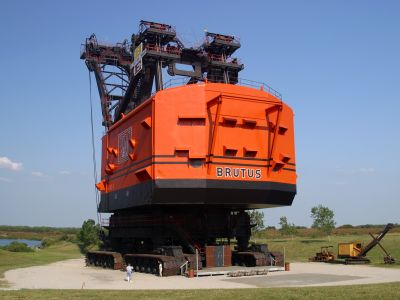
Big Brutus, Mining excavator in West Mineral, United States.
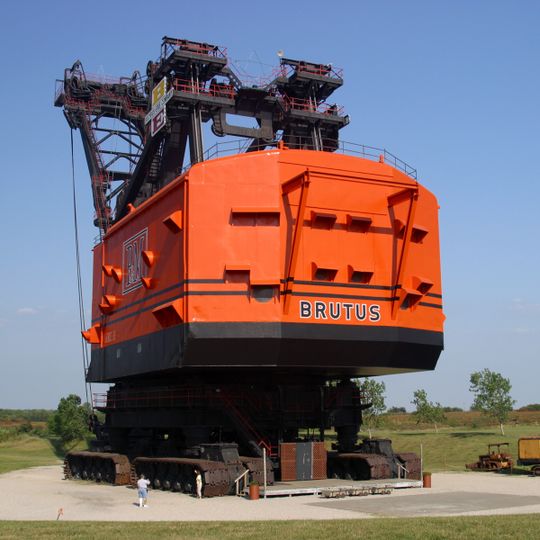
Big Brutus is the nickname of the Bucyrus-Erie 1850-B, an electric power shovel with a boxy orange upper housing marked with black stripes and the white word "BRUTUS" on its rear. It rests on four wide crawler tracks and carries a lattice boom of dark steel. Its bucket moved 69 cubic meters (90 cubic yards) per scoop.
The machine worked from 1963 to 1974 in the coal fields of southeastern Kansas. Pittsburgh and Midway Coal Mining Company donated it in 1984 for a museum.
The machine was named by Emil Sandeen, head of Mine 19, after the Roman assassin of Julius Caesar. The operator sat at the right front corner, with an oiler watching the automatic lubrication and a groundsman steering the four crawler tracks from a lower platform on instructions relayed by telephone or horn.
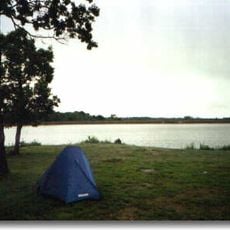
The boom has been closed to climbing since 2004 for safety reasons, so the machine is viewed from ground level and from the museum building beside it. The museum is open seasonally, with the busiest period between Memorial Day and Labor Day. Smaller strip-mining machines stand around Big Brutus, and the last worked pit is now a lake next to it.
The machine needed 150 railroad cars to reach its current site because it weighs five million kilograms. The electric drive consumed as much power as a small town with several hundred households.
The community of curious travelers
AroundUs brings together thousands of curated places, local tips, and hidden gems, enriched daily by 94,657 contributors worldwide.