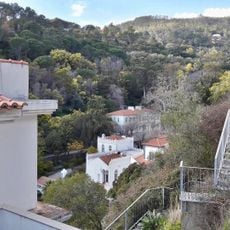
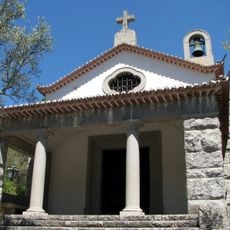
Convento de Nossa Senhora do Desterro, Franciscan monastery in Monchique, Portugal.
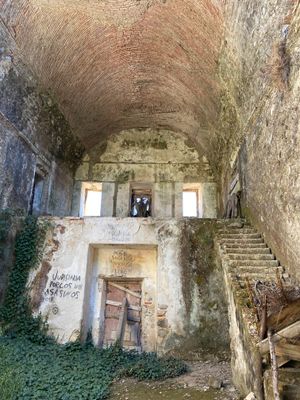
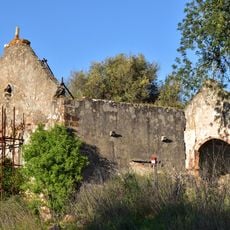
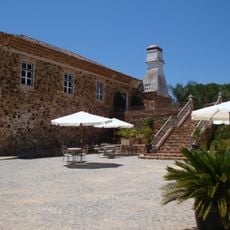
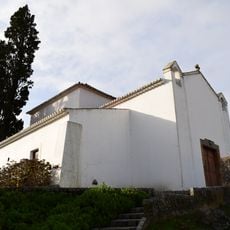
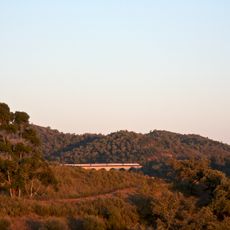
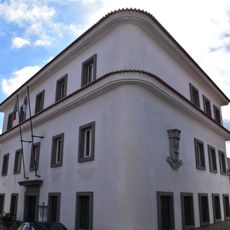
The Convento de Nossa Senhora do Desterro is a ruined former Franciscan monastery on a wooded slope of the Serra de Monchique, built in Manueline style around a quadrilateral cloister. Its tall gabled facade of rough grey plaster has a round-arched entrance with stone voussoirs, a stone medallion above, and three upper openings, one with a wrought-iron balcony. A lower wing with a tiled roof extends to the left, and faded red lettering marks the left wall.
Founded in 1631 by Pero da Silva, later Viceroy of India, the convent was taken over by the Franciscan Third Order on 20 March 1632. The 1755 earthquake destroyed the building, which was rebuilt afterwards. It closed in 1834 with the extinction of religious orders, was sold at auction in 1842 and divided into residential parcels before falling into ruin.
The convent is dedicated to Nossa Senhora do Desterro, whose 17th-century image is kept in the Ermida de São Sebastião in Monchique. Local tradition holds that the portaria atrium was used to give food to the village poor. In the former refectory, a tile panel reproduces Leonardo da Vinci's Last Supper.
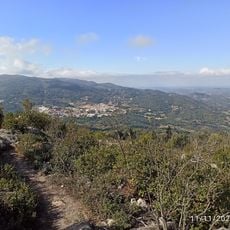
The monastery sits on private property but visitors can reach it via a walking path from central Monchique, expecting a moderate uphill route. Entering the grounds requires care and respect for the historical structures, which remain in varying states of preservation.
The convent's monumental magnolia, said to have been brought from India by founder Pero da Silva, was classified as public interest in 1947 and was once the largest magnolia in Europe. When it died in 2016 it measured 27 m tall, with a trunk 5.58 m around and a crown about 30 m across.
The community of curious travelers
AroundUs brings together thousands of curated places, local tips, and hidden gems, enriched daily by 93,361 contributors worldwide.