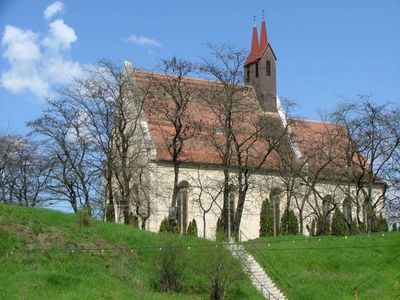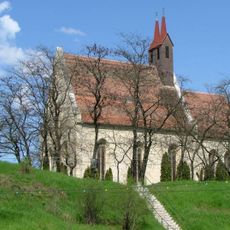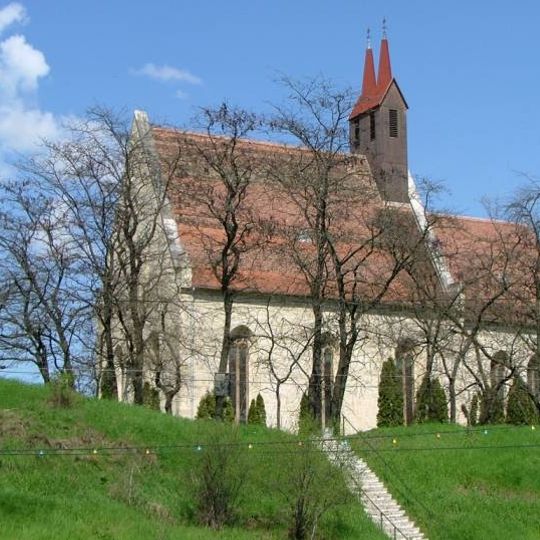
Cluj-Mănăștur Calvaria Church, Catholic church building in Mănăștur, Cluj-Napoca, Romania
Cluj-Mănăștur Calvaria Church is a medieval religious building standing on a strategic hilltop with high earthen embankments and traces of ellipsoidal fortifications from the Middle Ages. The structure displays Gothic architecture with a simplified nave that was built in the 19th century over ancient foundations.
The Benedictine abbey was founded in the second half of the 11th century, according to medieval tradition recorded in 1341, during the reign of King Ladislaus I of Hungary. Its first documentary mention is a papal bull of Pope Honorius III dated 21 June 1222. In 1202 the monastery became exempt from the Transylvanian bishopric, which led to armed conflicts with bishops Adrian and William. After the Tatar invasion of 1241 it was rebuilt by King Béla IV in 1263. It later passed to the Jesuits in 1581 and was largely destroyed by Tatars in 1661, leaving only the choir.
The church is also known as Kolozsmonostori apátság in Hungarian, recalling the Benedictine abbey founded here in the 11th century. Since 1994 it has served the Roman Catholic parish, which bought a 1792 organ built by Samuel Mätz of Biertan, brought from the Evangelical church of Daia Săsească after that village's Saxon community dissolved.
Access is through the southeast corner of the Calvaria hill, between the two earthen ramparts raised for defence. The church stands at Primăverii Street 60, in the Mănăștur district; the surrounding medieval earthworks and the slope to the north shape the approach.
North of the Gothic choir, excavations uncovered the ruins of a 13th-century Romanesque rotunda 8.60 m in diameter, with a profiled outer base and six inner apses. The present nave, rebuilt in 1896, stands on older foundations, so the site layers a rotunda, a Gothic choir and a 19th-century nave.
The community of curious travelers
AroundUs brings together thousands of curated places, local tips, and hidden gems, enriched daily by 93,054 contributors worldwide.