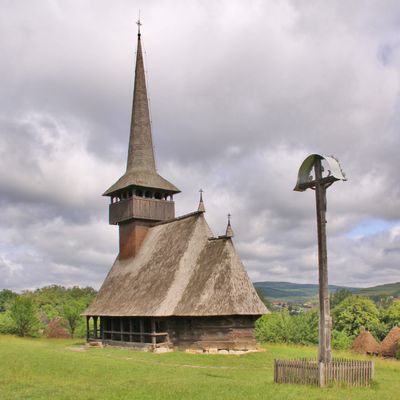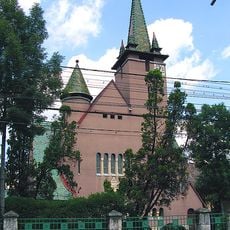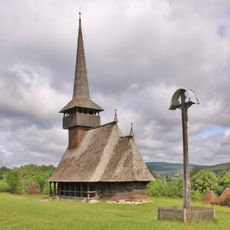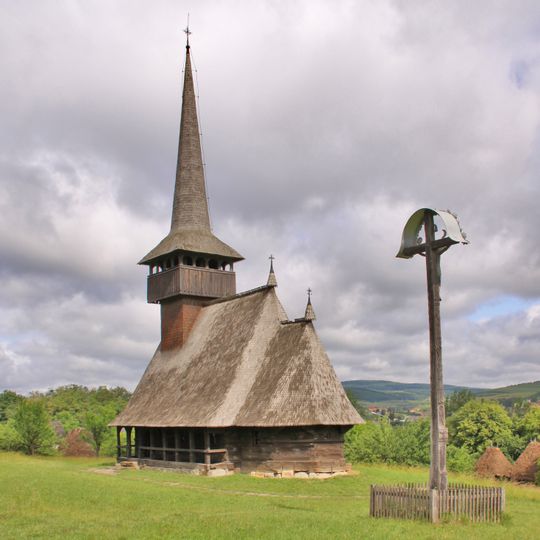
Wooden church in Cizer, Cluj, Wooden church and museum in Cizer, Romania.
The wooden church in Cizer is an Orthodox religious building constructed entirely from timber with traditional architectural elements including a bell tower and steeply pitched roof. The structure demonstrates regional construction methods common to Transylvanian churches, with carved wooden details and locally sourced materials throughout.
The church was built in 1773, as carved Cyrillic inscriptions above the doorways record, after the previous church burned in 1749 and services were held in a house for 24 years. Local tradition credits the master carpenter Horea (Vasile Nicula Ursu), with Nicula Ion a Neamțului; in 1776 Bishop Grigore Maior blessed it. In 1968 Valeriu Butură had it moved to the Cluj open-air museum.
Until the end of the 19th century the churchyard hosted the village assembly, presided over by the voivode, the knez or the village judge, and the village dance. Old memorial rites for the dead were held in and around the church until it was moved to the museum in 1968.
The church now stands inside the open-air Ethnographic Park "Romulus Vuia" in Cluj-Napoca, not in Cizer village, so visitors reach it on foot within the park grounds. Look for the carved inscriptions above the doorways: the Cyrillic line over the entrance to the porch reads "Ani de la H[ri]s[tos] 1773".
On a beam of the vault, in an unusual spot for a signature, is carved "lucrat Ursu H(orea)". Local tradition credits the church to Horea, who lived nearby on the Banffy estate; his testament records a debt of 44 florins to Nicula Ion a Neamțului, the master who built the church at Țăzeri.
The community of curious travelers
AroundUs brings together thousands of curated places, local tips, and hidden gems, enriched daily by 94,653 contributors worldwide.