Subotica Synagogue, Art Nouveau synagogue in Subotica, Serbia
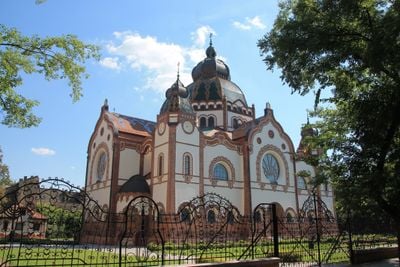
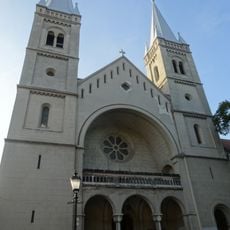
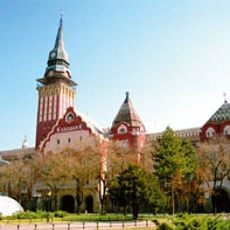
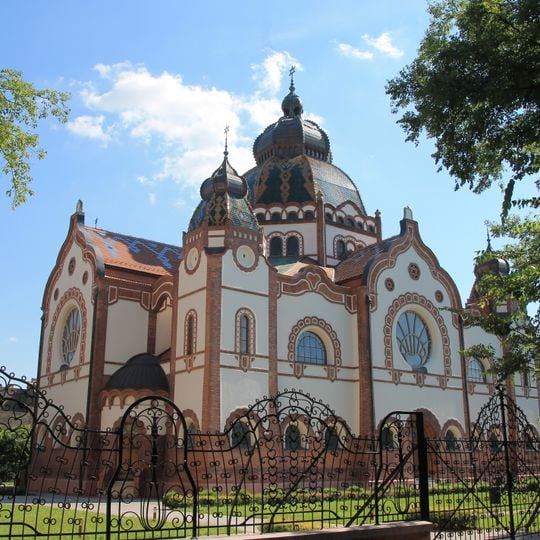
Subotica Synagogue is a symmetrical brick building with cream-colored walls and red-brick trim, completed in 1903. Its central mass rises to a tall, dark, multi-sided dome topped by a small finial, flanked by two smaller domed towers on the front corners. The main facade centers on a large arched window with radiating tracery beneath a curved gable, and rounded arches top the windows and doorways.
The Subotica Synagogue was built between 1901 and 1903 for a Neolog Jewish community of about 3,000 members, replacing an older, smaller synagogue. The community commissioned Budapest architects Marcell Komor and Dezső Jakab, followers of Ödön Lechner, to design it in the Hungarian Art Nouveau style. It was designated a national heritage site of great importance in 1974 and of exceptional importance in 1990.
The synagogue's name honours its architects, Marcell Komor and Dezső Jakab, and the square where it stands. Inside, the ground-floor prayer hall for men is dimmer than the galleries, lit by stained-glass windows whose arched panes each have a different colour scheme while repeating folk floral motifs. The large central brass chandelier was also meant to improve the acoustics under the dome.
The synagogue stands on Jakab and Komor Square, and its three entrance portals lead into a narthex with the women's gallery above; four staircases connect to the gallery. It reopened to the public in 2018 after a multi-million renovation, and it still serves the small local Jewish community for services while also hosting cultural events.
The dome is a self-supporting shell only 3 to 5 centimetres thick, a structural novelty for its time. Inside, four pairs of steel pillars clad in gypsum with palm-leaf relief carry the women's gallery and the dome, and the central chandelier was also meant to improve the acoustics under the dome.
The community of curious travelers
AroundUs brings together thousands of curated places, local tips, and hidden gems, enriched daily by 93,164 contributors worldwide.