Belgrade Fortress, Fortress in Stari Grad, Belgrade, Serbia
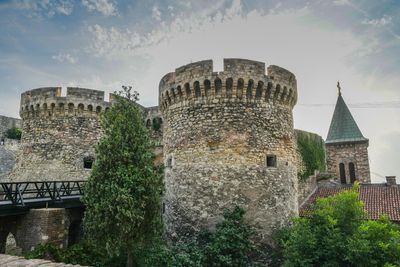
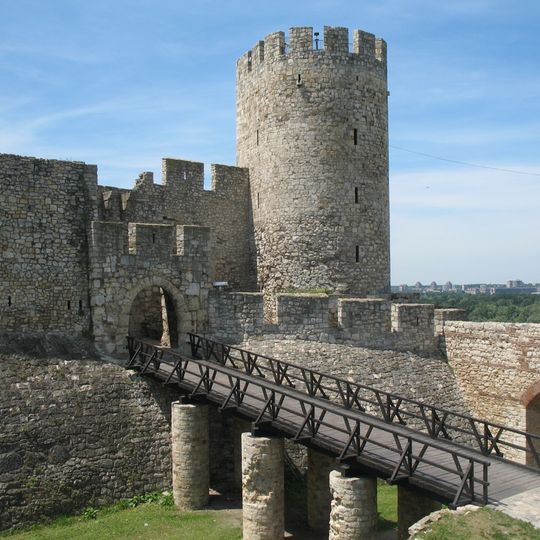
Belgrade Fortress occupies the ridge above the Sava-Danube confluence, divided into the Upper Town on the former Roman castrum plateau and the Lower Town along the river. Its walls are built of white Tašmajdan limestone, with a tall cylindrical tower pierced by narrow slits and a rounded arch gateway reached by a wooden footbridge on stone piers. A fluted stone column crowned by a standing figure holding an object aloft stands at the far right of the complex.
The site began as a Celtic settlement, Singidunum, in the 3rd century BC. In the 2nd century AD the Roman Legio IV Flavia Felix built a stone castrum on the Upper Town plateau. Byzantine emperor Justinian I rebuilt the fortress around 535, and in 1402 Despot Stefan Lazarević made it the capital of a Serbian despotate.
The complex houses museums dedicated to military history and displays weapons and uniforms spanning different periods of Serbian warfare. Visitors can observe tangible evidence of how soldiers lived and fought at this location across centuries.
The fortress grounds are free to enter and can be visited daily. The Upper Town plateau holds the Roman castrum remains and the military museum, while the Lower Town descends to the Sava and Danube banks. The ridge stands 125.5 metres above the river confluence, so paths between the two levels are steep.
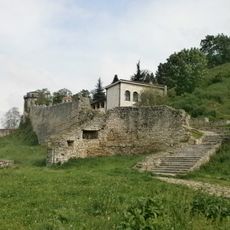
The fortress's oldest stone fortification, built by Legio IV Flavia Felix around AD 100, used white Tašmajdan limestone; its remains can still be seen near the northeastern corner of the acropolis. The legion also built a pontoon bridge over the Sava to Taurunum.
The community of curious travelers
AroundUs brings together thousands of curated places, local tips, and hidden gems, enriched daily by 94,369 contributors worldwide.