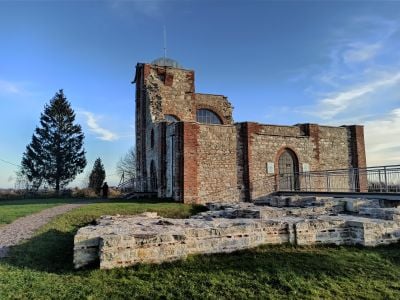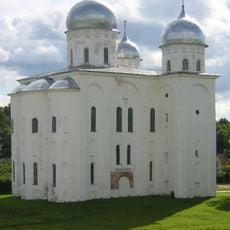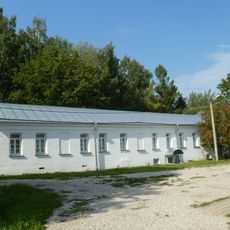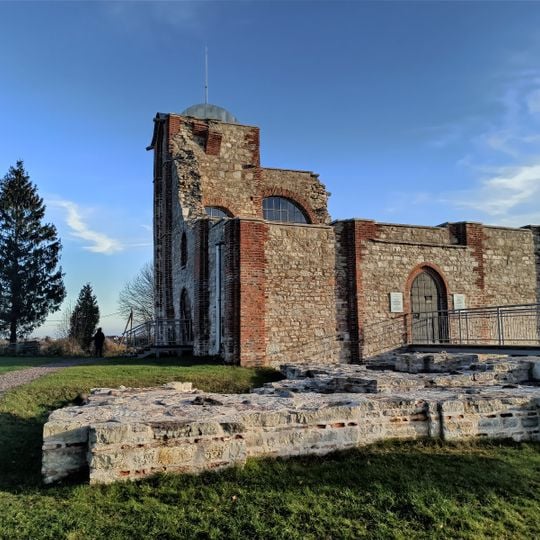
Rurikovo Gorodische, Archaeological settlement near Veliky Novgorod, Russia.
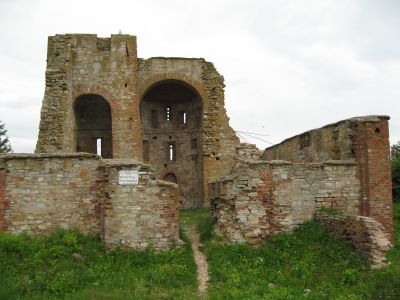
Rurikovo Gorodische is an archaeological site on the right bank of the Volkhov River where it flows out of Lake Ilmen, 2 km south of the Novgorod Detinets. The ruined stone and brick walls visible today include a central section with a large arched opening and a brick-lined recess holding small barred window holes, with a second narrower arch to the left and lower jagged wall fragments in front. Excavations have uncovered 9th-century wooden-earth fortifications, including oak frames dated by dendrochronology to 858–861.
Founded in the 9th century, the site was the capital of the Slovenes before Rurik's arrival and then of his state, serving as a military-administrative and trade centre. In 1103 the Novgorod First Chronicle mentions the Church of the Annunciation built under Mstislav Vladimirovich. In the early 11th century Yaroslav the Wise moved his residence to Yaroslav's Court, though the palace and workshops stayed in use; in the 15th and 16th centuries Moscow grand princes including Ivan III and Ivan IV stayed here.
The site holds meaning for those studying early medieval trade routes that connected Scandinavia with eastern Europe. The remains show how different peoples lived and worked together in this location.
The site lies about two kilometers south of Veliky Novgorod's city center and can be visited with guided visits. The warmer months offer the most comfortable conditions for exploring the grounds.
The name Rurikovo was added only in the 19th century by local historians; until then the tract and nearby village were simply called Gorodishche. The Old Norse name Hólmgarðr, usually applied to Novgorod, may also have referred to this site.
The community of curious travelers
AroundUs brings together thousands of curated places, local tips, and hidden gems, enriched daily by 94,534 contributors worldwide.