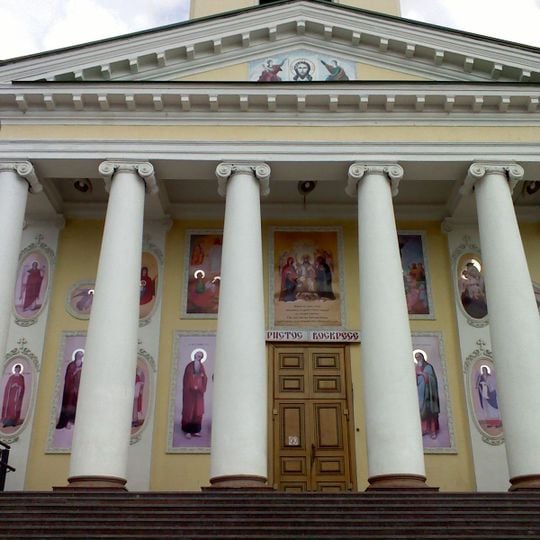
Alexander Nevsky Cathedral, Neoclassical Orthodox cathedral in Pervomaysky District, Izhevsk, Russia
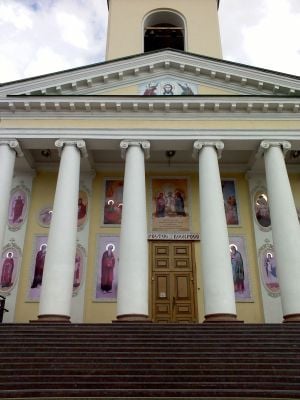
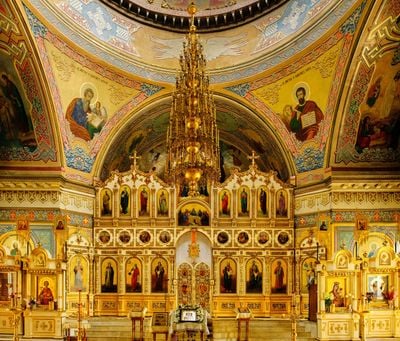
Alexander Nevsky Cathedral is a Neoclassical Russian Orthodox church in the Pervomaysky District of Izhevsk. Its pale yellow facade carries four white Ionic columns across three bays, framed painted panels of haloed figures, and a triangular pediment with a painted scene above paneled wooden doors. Inside, a multi-tiered gilded iconostasis fills the wall, with rows of full-length figures, round medallions and arched panels of saints, beneath a painted dome with a wide blue rim and white crosses.
After the 1810 fire destroyed Izhevsk's main church, the Prophet Elijah Church, factory architect Semyon Dudin's lavish design was rejected. In 1818 Luigi Ruska produced a design based on St. Andrew's Cathedral in Kronstadt, and Dudin began construction. The cathedral was completed in 1823 and visited by Emperor Alexander I in 1824. Closed in 1929, it housed the Koloss cinema from 1932, lost its cupola in 1937, and was returned to the church in 1990.
The cathedral is dedicated to Alexander Nevsky, a Russian prince who defeated Swedish and German forces in the 13th century and was later made a saint. His name is widely venerated across Russia, which gives this building a special meaning for local worshippers who attend its regular services.
The cathedral stands in the center of Izhevsk and can be reached on foot from most central points in the city. As in any active Orthodox church, modest dress is expected: shoulders and knees should be covered, and women typically wear a head covering.
The design of the cathedral is attributed to architect Andreyan Zakharov, who drew on the plans of St. Andrew's Cathedral in Kronstadt. Zakharov is best known as the designer of the Admiralty in Saint Petersburg, which connects this building in Izhevsk to one of the most recognized structures in Russia.
The community of curious travelers
AroundUs brings together thousands of curated places, local tips, and hidden gems, enriched daily by 93,138 contributors worldwide.