Roche moutonnée near Semyonovskoye Lake, Natural monument near Semyonovskoye Lake, Murmansk, Russia
This roche moutonnée near Semyonovskoye Lake is a rock formation shaped by ancient glaciers that moved across the northern landscape. The feature displays smooth, rounded surfaces on one side and steep, jagged faces on the other, showing how ice shaped the stone differently depending on the direction of pressure.
This formation was created during ice age periods when massive glaciers moved across the region and reshaped the landscape. It received official protection as a natural monument in 1980, ensuring its preservation.
The name "roche moutonnée" comes from the French for "sheep rock", after the rounded, fleece-like profile of the outcrop. The site is used for teaching: the direction and depth of the glacial grooves let students work out which way the ice moved and how thick it was. The mosses on the slopes include rare species such as Pohlia longicollis and Bryum turbinatum.
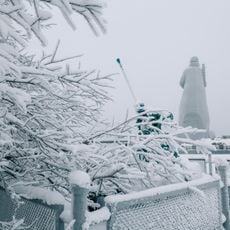
The monument lies in Murmansk's Leninsky district, about 400 m west of Semyonovskoye Lake and 1 km east of Kola Bay, near Askoldovtsev Street. Buses run along Prospekt Geroev-Severomortsev on the lake's eastern shore; from there, walk around the lake for just over 1 km. The 0.5-hectare site is bounded by housing, a border-guard plot and the Defenders of the Arctic memorial.
The rock surface bears fine scratches and grooves that resemble an engraved map, recording exactly which direction the glacier moved. These markings remain visible today and tell the silent story of ice age pressure and movement.
The community of curious travelers
AroundUs brings together thousands of curated places, local tips, and hidden gems, enriched daily by 94,607 contributors worldwide.