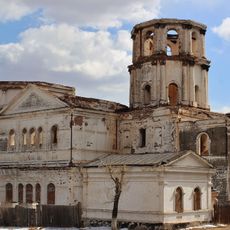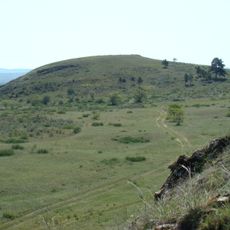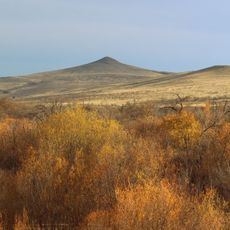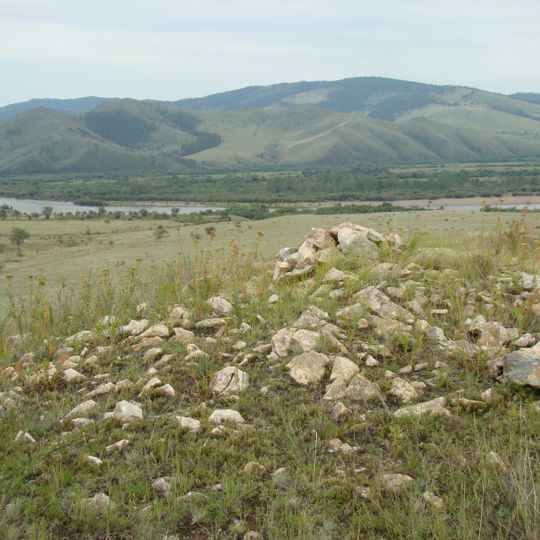
Дирестуйський Култук, Archaeological site in Dzhidinsky District, Russia.
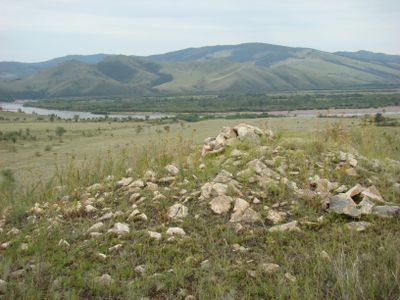
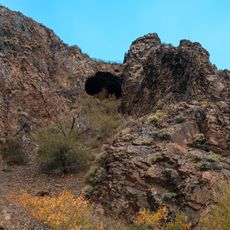
Dyrestuy Kultuk is a locality on the left bank of the Dzhida River, about 10 km southwest of Dyrestuy village in Buryatia. It holds a large Hunno-Sarmatian burial ground on a gentle northeast-facing slope, where stone cairns mark burials in wooden coffins or log frames, heads to the north. The wider tract also contains the Bayan-Under and Goly-Ochi cemeteries and a Hun-era fortified settlement.
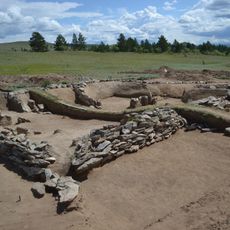
The Hun burial ground at Dyrestuy Kultuk was first excavated in 1900 by Yu. D. Talko-Grintsevich, who opened 24 Hun graves and two later burials. In 1965 P. B. Konovalov excavated nine more Hun graves and one Turkic burial. Between 1984 and 1996 S. S. Minyaev completed the work, investigating 95 additional Hun graves and two stone structures without burials.
The name Kultuk refers to the tract on the left bank of the Dzhida, where the Hun burials lie about 10 km southwest of Dyrestuy village. The graves yielded bronze openwork plaques showing animal combat, cowrie-shell imitations, malachite and carnelian earrings, and glass beads. The collections are now held in the Kyakhta Museum of Local Lore and in Ulan-Ude research institutes.
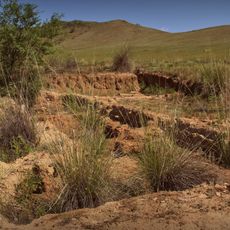
This site is protected by the state, so access is managed by local authorities and planning ahead makes sense. Visitors should prepare for outdoor conditions and uneven ground where the dig areas are exposed to the elements.
The cemetery was first excavated in 1900 by Yu. D. Talko-Grintsevich, who opened 24 Hun graves there and two later burials in a ravine 2.5 km to the southeast. Work resumed in 1965 under P. B. Konovalov and was completed between 1984 and 1996 by S. S. Minyaev, whose Transbaikal expedition examined 95 further Hun burials and two stone cairns that held no graves.
The community of curious travelers
AroundUs brings together thousands of curated places, local tips, and hidden gems, enriched daily by 93,132 contributors worldwide.