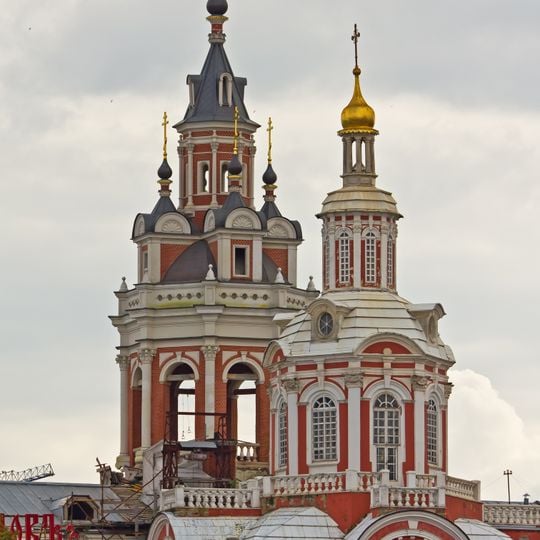
Zaikonospassky monastery, Orthodox monastery in Tverskoy District, Moscow, Russia
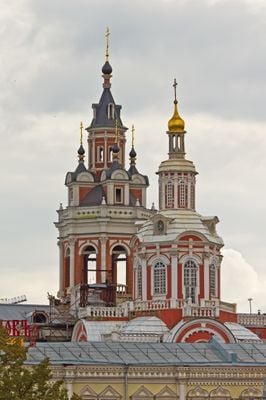
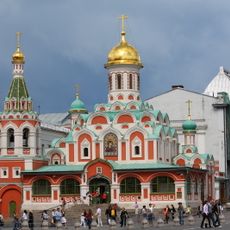
Zaikonospassky Monastery is an Eastern Orthodox monastic complex located on Nikolskaya Street in central Moscow, featuring historical stone structures. The site includes a cathedral, bell tower, and residential buildings that form the core of the compound.
Founded in 1600 by Boris Godunov and first documented in 1635, the monastery was called 'Saviour behind the icon shops' after the icon stalls on Nikolskaya Street. In 1665 Symeon of Polotsk ran a school for clerks here, and in 1687 the Likhud brothers' Greek school moved in, becoming the Slavic-Greek-Latin Academy. The academy moved to the Trinity Lavra in 1814.
The name means "Saviour behind the icon shops", from the rows of icon sellers that once stood along Nikolskaya Street. The monastery is remembered as "the teaching one": its superiors Symeon of Polotsk and Sylvester Medvedev turned it into a school, and a plaque honours its most famous student, Mikhail Lomonosov. Burials here include Symeon of Polotsk and Karion Istomin.
The monastery stands on Nikolskaya Street in Kitai-gorod, one block from the Kremlin. Much of the complex, including premises of 4,400 m², is occupied by the Russian State University for the Humanities, the Russian Orthodox University and postal and catering tenants, so only the Cathedral of the Holy Mandylion, reopened in 1992, is normally visited. The rebuilt belltower dates from 2014.
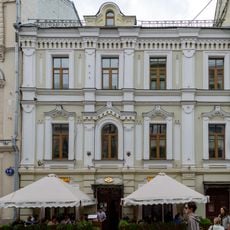
In 1931 a Soviet television studio moved into the monastery's house at No. 7, and from autumn 1934 its staff broadcast regular sound television from the monastery belltower until 1941. The belltower itself had been pulled down after the October Revolution and was rebuilt to the same design in 2014.
The community of curious travelers
AroundUs brings together thousands of curated places, local tips, and hidden gems, enriched daily by 93,914 contributors worldwide.