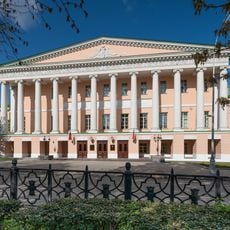
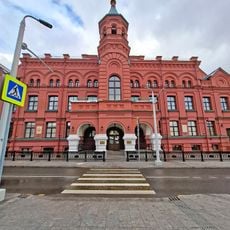
Moscow Police Building, Governmental building at Petrovka Street, Tverskoy District, Moscow, Russia
The Moscow Police Building, known as Petrovka 38, is a six-storey structure on Petrovka Street whose wings form a deep cour d'honneur. The 1952–1958 rebuild by architect Boris Mezentsev replaced an 1800 two-storey Empire-style mansion, presumably designed by Osip Bove, with Stalinist Empire forms: loggias with arched openings on the three lower floors and four-column porticoes with pediments above.
The site held the Shcherbatov princes' courtyard in the late 18th century; an early Empire-style manor, attributed to Osip Bove, appeared in 1800. The military department bought it in 1816 and converted it into the Petrovsky Barracks, rebuilt by Fyodor Shestakov in 1827 as a pretrial detention site where poet Nikolai Ogaryov was held in 1834. After the October Revolution it passed to the Moscow militia, and in 1952–1958 Boris Mezentsev rebuilt it as a six-storey Stalinist Empire complex.
The address Petrovka, 38 gave its name to the 1979 film "Petrovka, 38", based on Yulian Semyonov's novel, and the building appeared in the detective series "Sledstviye vedut ZnatoKi" in 1971. In 2016 a monument to the heroes of the film "The Meeting Place Cannot Be Changed" was unveiled in the inner courtyard.
The building sits in a central location with good public transport access nearby. Visitors should know this is an active government facility where access may be restricted to specific areas.
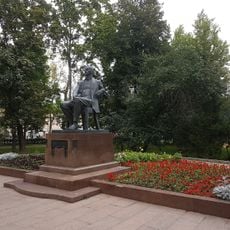
In 1977 a bust of Cheka founder Felix Dzerzhinsky by sculptor Anatoly Bichukov was placed in the inner courtyard. During the August 1991 events, staff removed it before a crowd reached Petrovka, and on 8 November 2005 it was returned to the courtyard.
The community of curious travelers
AroundUs brings together thousands of curated places, local tips, and hidden gems, enriched daily by 94,687 contributors worldwide.