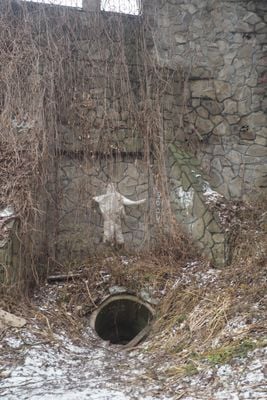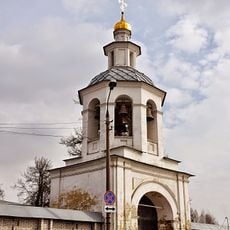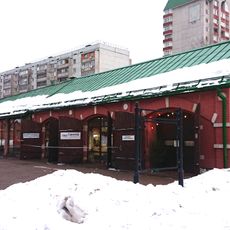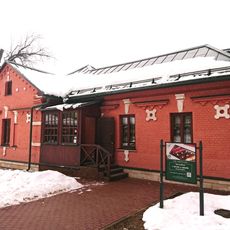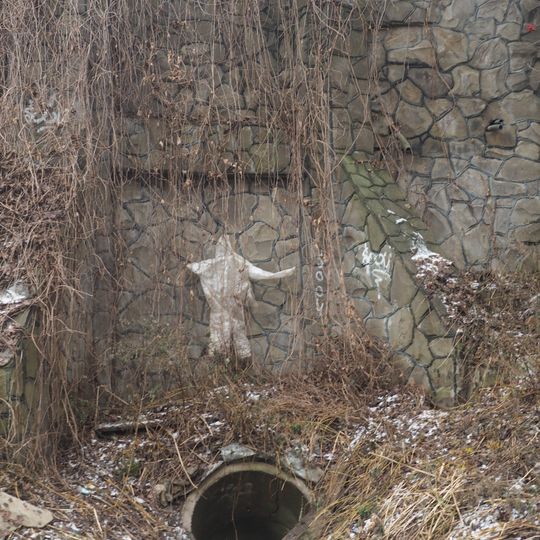
Kiseli, Underground quarry in Domodedovsky District, Russia.
Kiseli is a system of artificial limestone caves in Domodedovsky District, on the right bank of the Pakhra River beneath the village of Kamkino. Its passages include column-and-room workings, backfilled columns and continuous extraction zones. Surveyor A. Degtyarev measured the system at 13,730 m in 2001–2003 and 2012, against A. Vyatchin's 1982 figure of 9,500 m.
Limestone was quarried along the Pakhra from at least the 16th century. The Old and New Year systems were worked most actively in the 1780s, probably for the Tsaritsyno Palace, as four dates of 1785 and tally crosses counting blocks of 50 show. In the 19th century the Newest system supplied the Grand Kremlin Palace (1838–49) and the Bolshoi Theatre (1853–56).
The name Kiseli comes from the village of Kiselikha across the ravine, not from the non-existent Kiselikhinskaya quarry. Since the 1960s the system has drawn underground tourists who built grottoes such as Solnyshko (around 1985 by Gunkа) and Ermitazh (1987–1996). Count crosses carved on the walls tally extracted blocks, each stroke adding one, a full cross equalling 50.
Access requires sturdy footwear and reliable lighting since the ground is uneven and visibility is limited underground. Warm clothing is necessary because temperatures remain cool year-round in the underground space.
In the tunnels, miners recorded output with carved "counting crosses": each haulage block added one stroke, and a complete cross stood for 50 blocks. Four dates of "1785" and inscriptions in old script ("...ломчie 178.. м-ца апреля") survive on the walls. During construction of the Hermitage grotto (1987–1996), a human skeleton from the quarrying era was found in the rubble backfill.
The community of curious travelers
AroundUs brings together thousands of curated places, local tips, and hidden gems, enriched daily by 94,593 contributors worldwide.