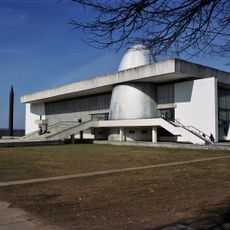
Kaluga planetarium, Planetarium in Kaluga, Russia
The Kaluga Planetarium occupies part of the building of the K. E. Tsiolkovsky State Museum of the History of Cosmonautics and opened together with the museum in 1967. Its hall seats 100 visitors and holds a Skymaster ZKP 4 projector made by the German firm Carl Zeiss. A 40.5 kg fragment of the Sikhote-Alin meteorite and several globes are displayed in the hall.
The Kaluga Planetarium opened in 1967 in the building of the Konstantin Tsiolkovsky State Museum of the History of Cosmonautics, with which it shares its premises. It has operated there since, giving astronomical and popular-science lectures in a hall of 100 seats.
The planetarium occupies the building of the Tsiolkovsky State Museum of the History of Cosmonautics and opened with it in 1967. Its hall holds a 40.5 kg fragment of the Sikhote-Alin meteorite and several globes, which visitors can examine alongside the shows.
The planetarium occupies the building of the Tsiolkovsky State Museum of the History of Cosmonautics. Its hall has 100 seats, and the projector is a Skymaster ZKP 4 made by Carl Zeiss. Look for the 40.5 kg fragment of the Sikhote-Alin meteorite and the globes on display in the hall.
In the planetarium hall stands a 40.5 kg fragment of the Sikhote-Alin meteorite, which fell in the Russian Far East in 1947, alongside several globes. The hall has 100 seats and a Skymaster ZKP 4 projector made by the German firm Carl Zeiss.
The community of curious travelers
AroundUs brings together thousands of curated places, local tips, and hidden gems, enriched daily by 94,075 contributors worldwide.