Moskovsky Victory Park, Memorial park in Moskovsky District, Saint Petersburg, Russia.
Moskovsky Victory Park is a 68-hectare green space in the Moskovsky District featuring numerous ponds, canals, wide avenues, and flower gardens. The grounds contain more than 100 varieties of trees and bushes that create different areas and outlooks throughout the layout.
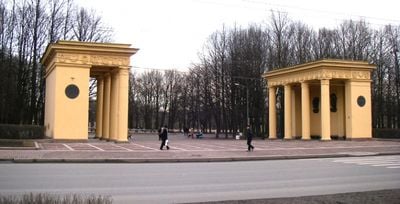
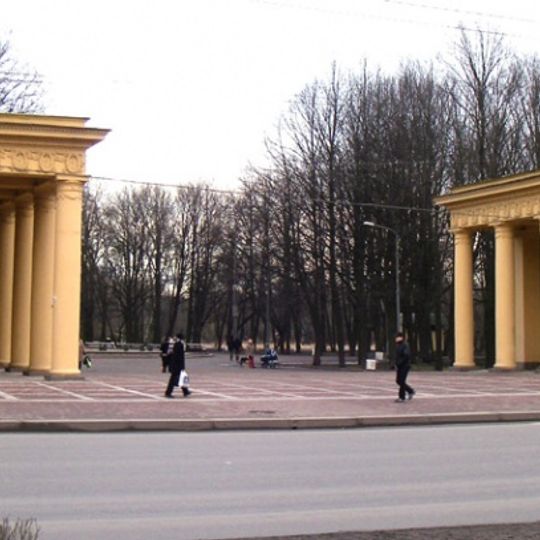
The park was first laid out in 1939–1941 as a Park of Culture and Rest, designed by architect Tatyana Dubyago on the site of Brick and Pumice Factory No. 1, opened in 1931. During the Siege the factory burned the dead, and ashes were dumped into flooded clay pits. The park was re-founded on 7 October 1945 as Victory Park, opened on 7 July 1946, and completed in 1957 with the main entrance propylaea.
The Alley of Heroes runs from the main entrance propylaea and fountain toward the sports and concert complex, separating the regular and landscape parts of the park. It holds busts of Leningraders twice awarded Hero of the Soviet Union, later joined by other Leningraders twice named Hero of Socialist Labour. Monuments include Marshal Georgy Zhukov, Zoya Kosmodemyanskaya and Alexander Matrosov.
The main entrance with its two propylaea and the Wreath of Glory fountain faces Moskovsky Avenue; the Park Pobedy metro station sits at the park's south-west edge. The Alley of Heroes runs from the entrance toward Yuri Gagarin Avenue, dividing the regular part from the landscape part. Five pedestrian bridges with metal spans, built in 1976, link the banks of the ponds.
The ponds have names tied to the war: the Admiralty pond is an old flooded pit where ashes of people cremated during the Siege were dumped, carried there in mine cars. The paired pond known as "Ochki" ("Glasses") predates the park and appears on pre-revolutionary city maps.
The community of curious travelers
AroundUs brings together thousands of curated places, local tips, and hidden gems, enriched daily by 93,328 contributors worldwide.