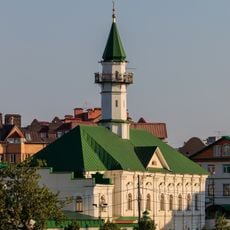
Печән базары, Cultural market square in central Kazan, Russia.
Sennoy Bazaar (Tatar: Pechän bazarı) was a trading square in Kazan's Old Tatar Quarter, laid out at the end of the 18th century on the site of a Khanate-era Muslim cemetery. It formed an elongated rectangle along the Bulak, ringed by revenue houses, inns, shops and bathhouses; its centre was the Sennaya Mosque, now Nurulla, built in 1845 to a design by P. G. Peske. Ground floors served as shops, warehouses and workshops, upper floors as housing.
The bazaar square was laid out at the end of the 18th century under Kazan's regular plan of 1768, on the site of a Muslim cemetery from the Kazan Khanate period. It was an eastern bazaar with a characteristic set of buildings. It ceased to exist in 1932.
The bazaar's name comes from the hay (seno) once sold there, and it appears in Gabdulla Tukay's 1908 poem "Peçän bazarı, yäxud Yaña Kisekbaş". Its centre was the Sennaya Mosque, now the Nurulla Mosque, built in 1845 to a design by P. G. Peske.
The bazaar no longer exists: it closed in 1932, and its site is now crossed by Moskovskaya Street between the Bulak and the wide Tatars tan avenue. Look for the Truda public garden with its restored Stalin-era fountain and sculpture group "Workers on the Globe". The former square's centre, the Sennaya Mosque (now Nurulla), stands nearby.
The bazaar no longer exists: it closed in 1932, and its site is now crossed by Moskovskaya Street and occupied in part by Skver Truda. There stands the restored Stalin-era fountain-sculpture group "Workers on the Globe", brought back in the 2010s.
The community of curious travelers
AroundUs brings together thousands of curated places, local tips, and hidden gems, enriched daily by 94,737 contributors worldwide.