Zheleznov's mansion, Regional heritage estate in Yekaterinburg, Russia.
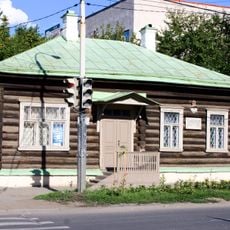
Zheleznov's mansion is a Russian Revival estate at 56 Rozy Luxemburg Street in Yekaterinburg, built in 1892–1895 by architect Yu. O. Dyutel (or, per other sources, A. B. Turchevich). The main house with a mezzanine and basement stands beside a one-story brick wing, linked by a massive stone wall with metal grilles and arched gates. Brick details imitate wood carving, and the house resembles a red-brick Russian terem.
The estate was built in 1892–1895 in the Russian Revival style by Yekaterinburg architect Yu. O. Dyutel, according to some sources A. B. Turchevich, for hereditary honorary citizen Alexei Nikitich Kazantsev, who bought the plot at auction in 1891 from the ruined gold miner Kharitonov. Alexei Anfinogenovich Zheleznov, who made his fortune in gold mining and in the sale of gunpowder and dynamite, acquired it around 1905; no evidence places him on Zlatoustovskaya Street before 1907. After the revolution anarchists occupied the house, then a military unit was formed there, and it passed to the People's Commissariat of Education.
The estate's name comes from Alexei Anfinogenovich Zheleznov, a gold-mining and gunpowder merchant who bought it around 1905; no evidence places him on Zlatoustovskaya Street before 1907. He was a keen horseman who headed Yekaterinburg's horse breeders' society and rode in races in Yekaterinburg, Tyumen and even Saint Petersburg. The brick details are carved to imitate wooden fretwork, and the house is compared to the Igumnov merchant house in Moscow.
The estate stands at Rozy Lyuksemburg Street 56, on the block once called Zlatoustovskaya Street until 1919. The main house with its mezzanine and the one-storey wing are joined along the street by a massive stone wall with metal grilles and arched gates on decorated pillars. The garden that once sloped down to the river is now overgrown and its marble fountain no longer runs.
During the Great Patriotic War the State Astronomical Institute named after P. K. Sternberg was evacuated here from Moscow. Its precise-time chronometers were kept in the cellars behind brick walls about 1.5 m thick, far from traffic arteries, under M. S. Zverev.
The community of curious travelers
AroundUs brings together thousands of curated places, local tips, and hidden gems, enriched daily by 93,136 contributors worldwide.