Granhult Church, Medieval wooden church in Småland, Sweden
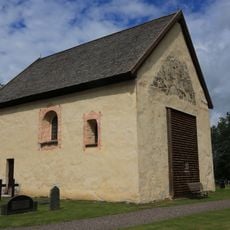
Granhult Church is a wooden structure in southern Småland built from horizontally placed tree logs, with exterior walls and roof entirely covered in wooden shingles. The building has a simple rectangular shape typical of medieval rural churches in the region.
Dendrochronological analysis dates the church timber to just after 1217, and the building is thought to have been raised in the 1220s. When the parish was merged into Nottebäck and formally closed in 1837, the parishioners refused to demolish it. It regained the right to hold services in 1879; in the late 19th century Kulturen in Lund considered buying and moving it, but Bosebo Church was moved instead.
The walls carry paintings from 1753 by Johan Christian Zschotzscher, showing scenes from chapters four and five of Revelation: the Lamb with a cross banner in the chancel ceiling, and a medallion of God on his throne of glory in the nave. Medieval painting fragments survive on the triumphal arch and the eastern chancel wall. The sacristy walls hold 17th-century scenes of Adam and Eve, the Fall and Abraham's sacrifice.
The church stands by a gravel path in the forest near Granhult, with the cemetery enclosed by a grey stone wall entered through an 18th-century lychgate. The open bell tower with two bells rises just beside the building. The interior is small and unheated, so allow time to examine the paintings and carvings closely.
On the south side of the chancel, between two logs, a small opening with a sliding shutter is cut into the wall: a hagioscope. Through it, people barred from communion by the Catholic Church could follow the Mass and pray facing the altar. Traces of the original windows, smaller and set higher than the present 18th-century ones, remain visible in the facade.
The community of curious travelers
AroundUs brings together thousands of curated places, local tips, and hidden gems, enriched daily by 94,014 contributors worldwide.