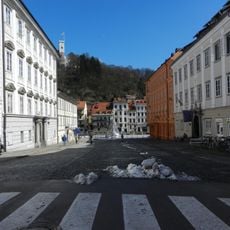
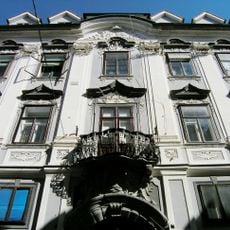
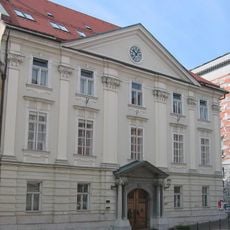
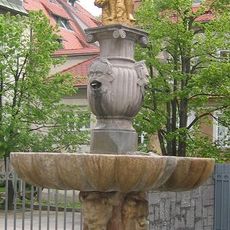
Cobblers' Bridge, Stone pedestrian bridge in Ljubljana, Slovenia
Cobblers' Bridge is a 27.30-metre concrete pedestrian bridge over the Ljubljanica, with a 7-metre roadway and two 1.975-metre pavements. Its balustrade has pillars in five fields between square pylons, and two central columns with capitals and small spheres carry three-headed lamps with bronze tips.
A wooden bridge, the Upper Bridge, stood here by the 13th century and was Ljubljana's second-oldest crossing. Butchers' stalls lined its edges, giving it the name Butchers' Bridge; in 1614 the butchers were moved downstream over epidemic fears. After a fire in 1864 (or 1854), shoemakers' booths replaced them, and the crossing became the Cobblers' Bridge. A cast-iron bridge cast at Dvor followed in 1867, named Hradecky Bridge after mayor Janez Nepomuk Hradecky; Jože Plečnik's concrete bridge was built in 1931 and opened to traffic on 4 July 1932.
The bridge takes its name from the shoemakers' booths installed after the butchers were moved away in 1614; a Christ statue stood among those booths before being transferred to St. Florian's Church. In the 1990s the flea market held on the bridge moved to the left bank of the Ljubljanica after Brege was repaved.
The bridge is 27.30 m long, with a 7.0 m roadway and two 1.975 m pavements, and it links the Old Town around Mestni trg with the New Square (Novi trg) area. It is pedestrian-only, so cross on foot; the flat deck and balustrade make it easy to navigate. Look for the Ivan Hribar monument unveiled beside the bridge in 2010.
The bridge's central roadway slab is supported midway by a double-arch structure; on its cantilevered section stand two emphasised columns with capitals, topped by three-flame lamps protected with bronze points. The original pillars were moved to the Plečnik Museum in Trnovo during the 1990s renovation.
The community of curious travelers
AroundUs brings together thousands of curated places, local tips, and hidden gems, enriched daily by 94,015 contributors worldwide.