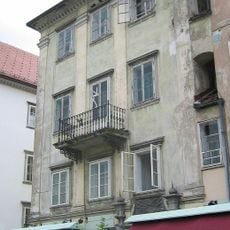
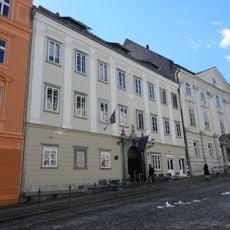
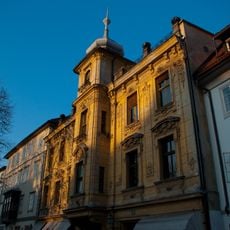
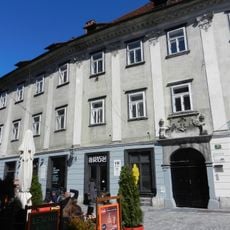
New Square, Square in Ljubljana, Slovenia
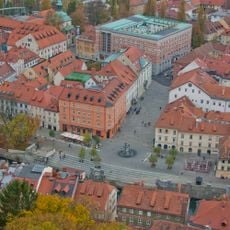
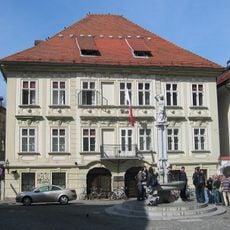
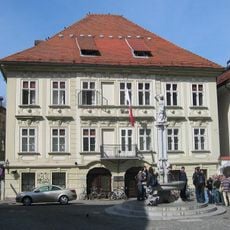
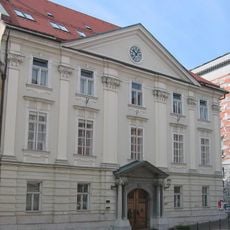
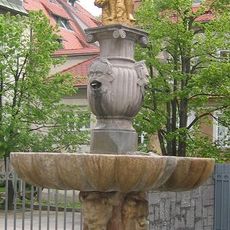
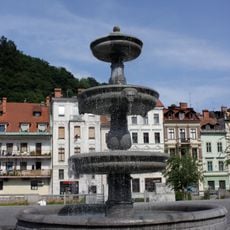
New Square is a rectangular square running west to east, almost perpendicular to the Ljubljanica. It is closed to the west by the junction of Gosposka and Turjaška streets and to the east by Breg. At its western end stands the Baroque Lontovž palace, seat of the Slovenian Academy of Sciences and Arts, and near the river a fountain made from shells of a Baroque fountain from the Auersperg gardens, rebuilt to a design by Boris Kobe.
The area belonged to the Spanheim family, who gave part of it to the Teutonic Order in the early 13th century. The square is first mentioned in 1307, and by the late 15th century a vice-dominus settled here. It was renamed Turjaški trg in 1876, Karl Marx Square in 1923, and reverted to Novi trg in 1928.
The name Novi trg (New Square) is documented from 1307. It was renamed Turjaški trg or Auerspergplatz in 1876 for Count Anton Auersperg's 70th birthday, became Karl Marxov trg in 1923, and reverted to Novi trg in 1928. Židovska ulica, the street heading north, preserves the area's medieval layout.
The square is easily reached on foot from Ljubljana's main streets and sits near public transportation stops. Visitors should note that the paved surface can become slippery in rain, and comfortable shoes are helpful for exploring the area.
The square's fountain is made from shell-shaped pieces of a Baroque fountain from the Auersperg gardens, rebuilt to a design by architect Boris Kobe. The four houses that once closed the square toward the Ljubljanica were demolished after earthquake damage; the most beautiful, a Renaissance building with a corner bay, came down in 1913.
The community of curious travelers
AroundUs brings together thousands of curated places, local tips, and hidden gems, enriched daily by 94,391 contributors worldwide.