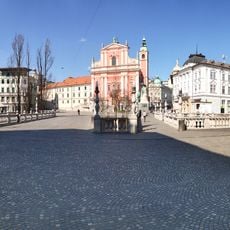
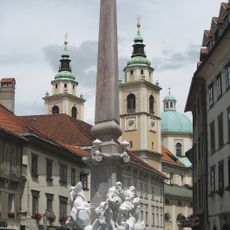
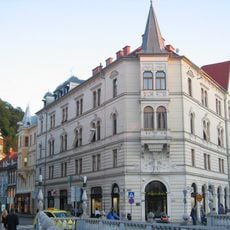
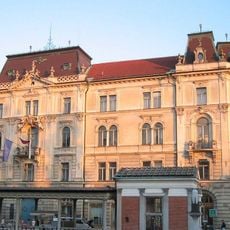
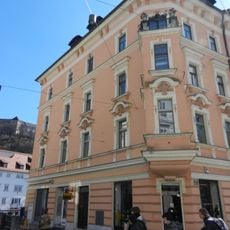
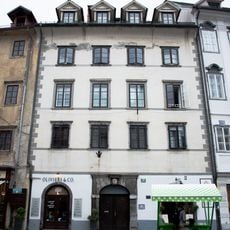
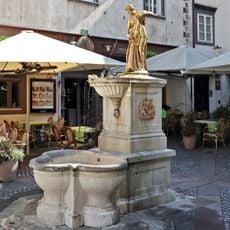
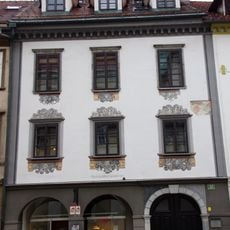
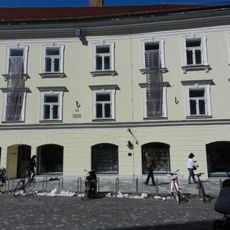
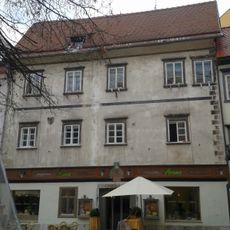
Souvan House, Monument of local significance in Town Square, Ljubljana, Slovenia.
Souvan House is a seven-axis building at 24 Town Square, created around 1755 by merging two older houses. Its present appearance dates from 1827, when Francesco Coconi added a fourth storey and a shallow avant-corps crowned by a triangular pediment. The facade is divided into three bands: the ground floor, two lower storeys framed by Corinthian pilasters and half-columns, and smooth upper storeys.
Built at the end of the 17th century, the house was formed around 1755 by merging two older buildings into a seven-axis house with a Baroque staircase and facade. In 1827 the architect Francesco Coconi raised it with a fourth floor and gave it its present facade for the merchant and bookbinder Henrik Adam Hohn.
The facade displays detailed reliefs by sculptor Martin Kirschner showing scenes of trade, art, and agriculture. These carvings reflect the economic importance this square held for the city.
The building sits on Town Square directly across from the Town Hall, making it easy to spot from the public space. Take time to view the facade from different angles across the square to fully appreciate the relief details.
Architect Francesco Coconi did more than just redesign the facade during the 1827 renovation, he actually raised the entire building. This uncommon approach showed his innovative strategy for adapting older structures to contemporary standards.
The community of curious travelers
AroundUs brings together thousands of curated places, local tips, and hidden gems, enriched daily by 93,546 contributors worldwide.