Kresija Palace, Neo-Renaissance palace in Old Town, Ljubljana, Slovenia
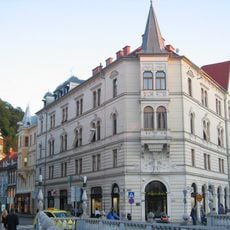
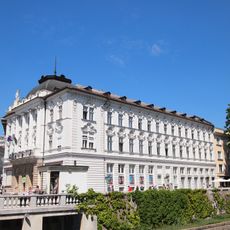
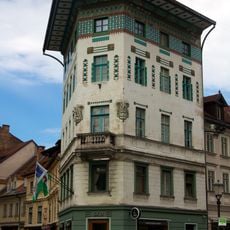
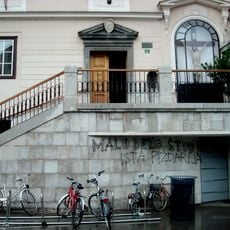
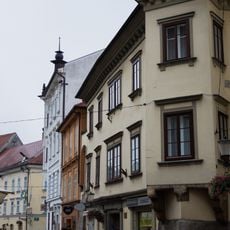
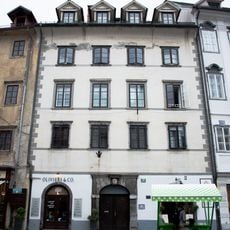
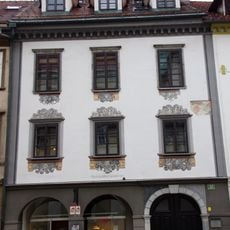
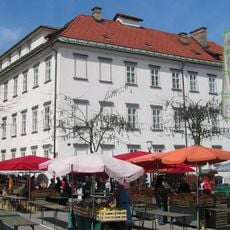
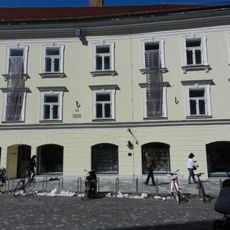
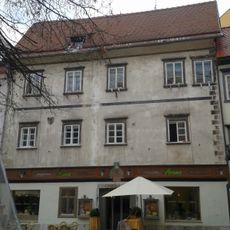
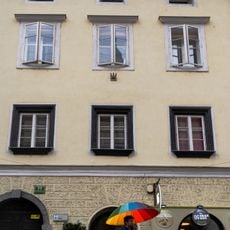
Kresija Palace is a Neo-Renaissance building with an irregular square plan and an inner courtyard, erected in 1897–1898 to designs by Graz architect Leopold Theyer. Its entrance portal faces the Adamič and Lunder Embankment; above a wrought-iron balcony, the Ljubljana coat of arms sits in a cartouche flanked by two genii sculpted by Alojzij Repič. A corner turret marks the entrance to the old town.
The site held a town hospital for the poor, first mentioned in 1326 and founded by the Hungarian queen Elizabeth, with St. Elizabeth's Church standing beside it from 1345 to 1831. A Protestant Latin school operated there from 1563 to 1598 under headmaster Adam Bohorič. After the 1895 earthquake, Graz architect Leopold Theyer designed the present building, erected in 1897–1898, whose name comes from the German Kreisamt, the district office that occupied its first floor from 1816 to 1849.
The southwestern facade displays memorial busts of Adam Bohoric, a Protestant scholar of language, and Marko Gerbec, a physician who shaped Slovenian intellectual life. These portraits honor figures whose work left a lasting mark on regional thought and learning.
The building houses municipal offices, a tourist information center, and the Kresija Gallery, making it a convenient stop for visitors seeking city services or cultural exhibits. Its riverside location provides easy access to other Old Town attractions nearby.
A plaque beneath a northwestern turret marks where paramilitary forces were stationed during Slovenia's 1991 independence movement. This often-overlooked detail connects the building to a pivotal moment in the country's recent history.
The community of curious travelers
AroundUs brings together thousands of curated places, local tips, and hidden gems, enriched daily by 93,663 contributors worldwide.