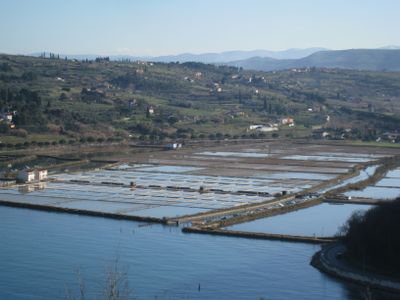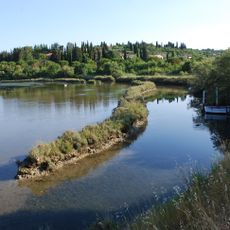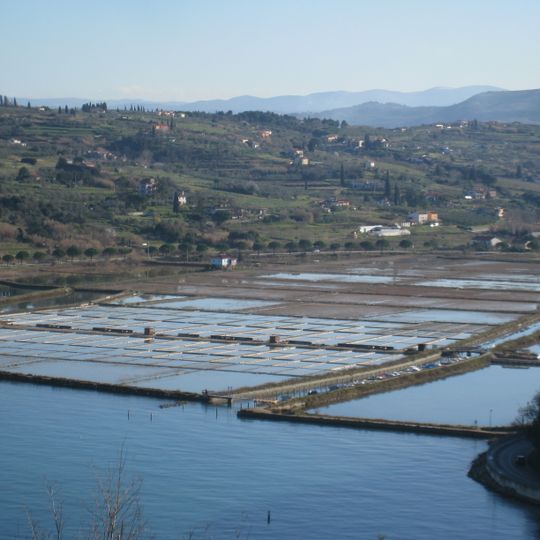
Strunjan Salina, Working salt pans in Strunjan Landscape Park, Piran Municipality, Slovenia.
Strunjan Salina is a salt production site along the Adriatic coast where shallow basins within a protected natural area allow traditional seawater harvesting. The facility consists of multiple evaporation ponds of varying sizes and depths that concentrate saltwater through natural evaporation.
Salt production at Strunjan was discussed at the Rižana Assembly in 804 and first explicitly recorded in the Piran Statute of 1274, which set production, sale and price conditions. Between the 15th and 17th centuries these pans ranked with Sečovlje as the most important of the Venetian Republic. Working stopped in 1967 and resumed in the 2000s.
Salt was made by the family method: a salter and his household moved into the pans from St George's Day, 23 April, until St Bartholomew's Day, 24 August, when a mass gave thanks for the harvest. Workers came from Piran, Izola and Koper, and the trade passed from generation to generation.
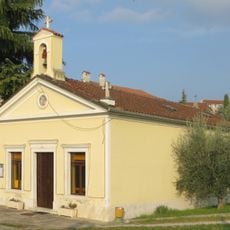
The salt pans lie in Strunjan Bay, within Strunjan Landscape Park, and are reached by marked paths from Strunjan village. The working season runs from St George's Day on 23 April to St Bartholomew's Day on 24 August, when salt is harvested; outside these months the pans are maintained and prepared. The three salt workers' houses are protected monuments, and the older one has a ground-floor salt store with family quarters above.
The salt pans are the northernmost still-working salt pans in the Mediterranean, and the Roja stream, also called the Strunjan River, empties into the sea through them. Three salt-worker houses survive on the site, two built in the early 20th century and one in the 17th or 18th century; the older one has salt stored on the ground floor and the family living above.
The community of curious travelers
AroundUs brings together thousands of curated places, local tips, and hidden gems, enriched daily by 93,181 contributors worldwide.