Guggenheim Museum

Log in to your account

AroundUs is a community-driven map of interesting places, built by curious explorers like you. It grows with every review, story, and photo you share.
Connect to save your favorite spots, contribute locations, and create personalized routes.
By continuing, you accept our Terms and Conditions and our Privacy Policy

Guggenheim Museum

Add to collection
Map
Suggest a change
Share

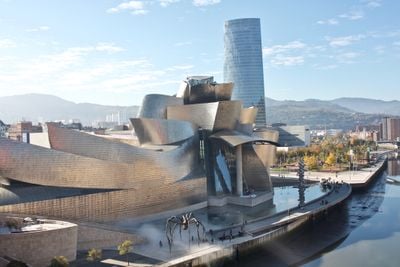
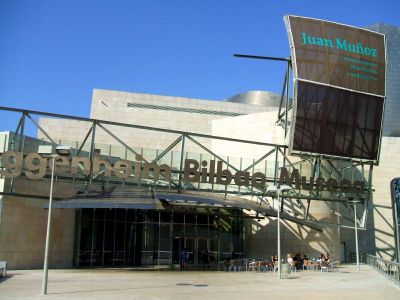
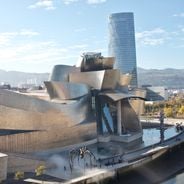
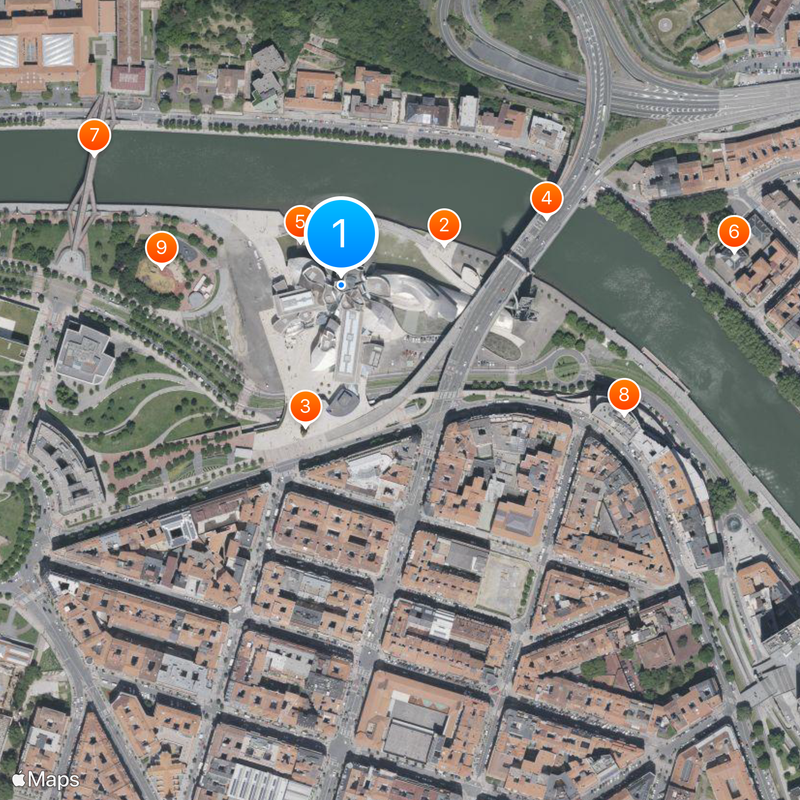
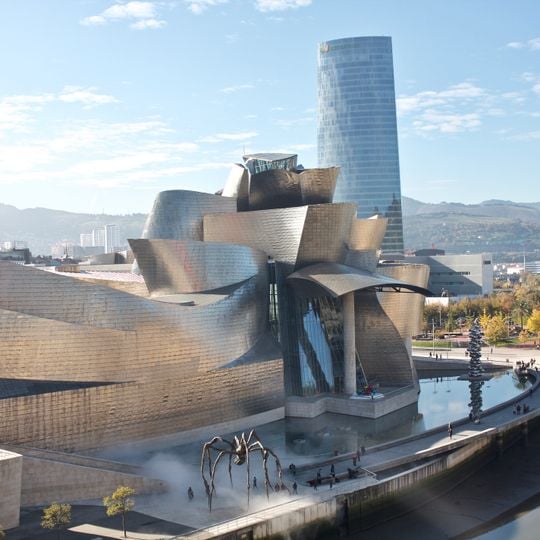
Guggenheim Museum, Contemporary art museum in Abando district, Bilbao, Spain.

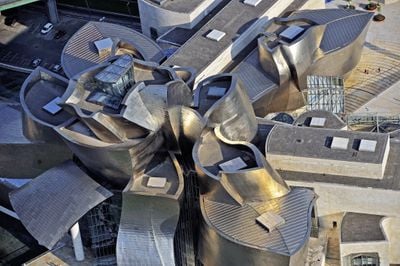
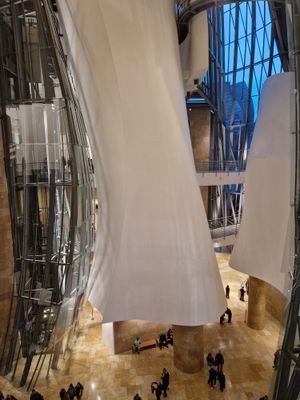
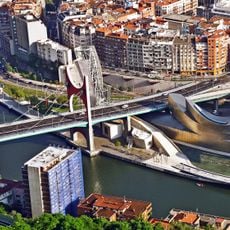
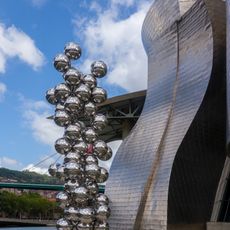
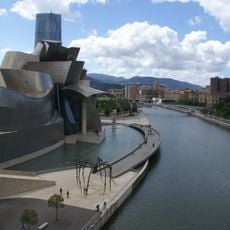
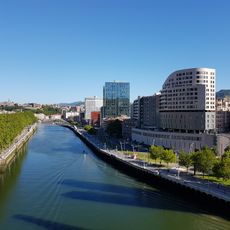
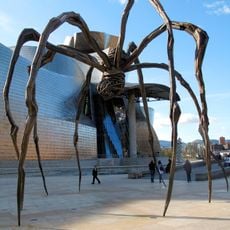
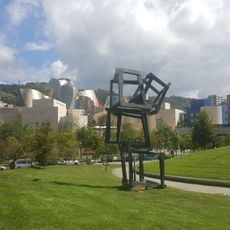
The titanium-clad structure with curvilinear forms stands along the Nervion River, featuring glass and limestone walls across multiple exhibition levels.

The Basque Government funded the 100-million-dollar construction in 1991 to regenerate the industrial port area of Bilbao through modern architecture.

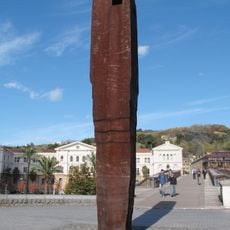
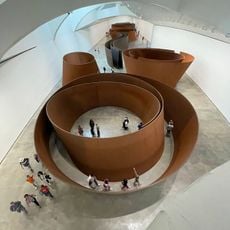
The permanent collection includes international contemporary art installations, with Richard Serra's large steel sculptures occupying the main gallery space.

The museum operates from Tuesday through Sunday between 10:00 AM and 7:30 PM, with reduced hours on December 24 and December 31.

The building design required 25,000 tonnes of concrete and reinforced piles driven 14 meters deep into bedrock for structural stability.

Location: Bilbao

Inception: October 18, 1997

Architects: Frank Gehry

Official opening: October 18, 1997

Accessibility: Wheelchair limited access

Fee: Yes

Part of: Solomon R. Guggenheim Foundation

Address: Avenida Abandoibarra, 2

Opening Hours: Tuesday-Sunday 10:00-19:30; Monday off; December 24,December 31: 10:00-17:00; December 25,January 01: off

Phone: +34944359080

Email: informacion@guggenheim-bilbao.eus

Website: https://guggenheim-bilbao.eus

GPS coordinates: 43.26883,-2.93410

Latest update: May 26, 2025 19:05

Modern 21st-century architecture: skyscrapers, museums, and landmark buildings

20th and 21st-century architecture has transformed city centers with structures that push engineering boundaries. Observation towers like the Seattle Space Needle and experimental residential complexes like Habitat 67 in Montreal demonstrate the evolution of construction techniques. Architects have explored new forms using materials such as steel, glass, and concrete, creating structures that meet the growing demands of metropolitan areas. This collection includes buildings that marked their time with innovative design. In Barcelona, Antoni Gaudí's Casa Milà features a wavy facade that breaks traditional norms, while in London, 30 St Mary Axe incorporates energy-saving technologies into its 180-meter structure. From Bilbao's Guggenheim Museum clad in titanium to artificial islands shaped in the Persian Gulf in Dubai, these projects illustrate the diversity of architectural approaches worldwide. Each building reflects its urban context while offering solutions to technical and functional challenges of its era.

Architecture: famous buildings, modern and historical structures

This collection presents significant architectural works from different periods and continents. From medieval cathedrals to contemporary skyscrapers, the selection documents the technical and aesthetic development of building design. The listed buildings were created by influential architects and have shaped the evolution of modern architecture. The list includes religious structures such as Gothic churches and monasteries, public facilities like museums and concert halls, and residential buildings that established new construction standards. Each building demonstrates particular structural solutions or stylistic features that contribute to understanding architectural history. The selection offers insights into various building styles, materials and construction methods.

Circular monuments and buildings: amphitheatres, towers, rotundas

Circular architecture has fascinated builders since ancient times. This collection brings together Roman amphitheatres like the Colosseum, medieval towers such as the Round Tower in Copenhagen, baroque domed structures and modern constructions. The circular form offers practical advantages for acoustic properties, structural stability and optimal space usage. The selected buildings serve various functions: religious temples, fortifications, observatories, museums and event venues. Each example demonstrates how architects have adapted the circular form to local conditions and cultural requirements. From ancient stone structures to contemporary skyscrapers, this selection documents technical evolution across centuries.

The most incredible structures in the world

Architecture does not have to follow straight lines and right angles. This collection presents buildings that stand out through their form: domes, spirals, tilted facades or organic structures that recall animals or plants. From Gaudí's mosaic covered works in Barcelona to the stacked concrete cubes of Habitat 67 in Montreal or the conical trulli of Alberobello, these structures demonstrate alternative approaches to construction. Some emerged from technical necessity, such as the temporary cardboard cathedral in Christchurch after the 2011 earthquake. Others are artistic statements: the Guggenheim Museum in Bilbao with its titanium plates, the Dancing House in Prague or the cubist houses in Rotterdam. In Đà Lạt, the Crazy House transforms tree trunks and caves into habitable spaces, while the Atomium in Brussels represents a magnified iron crystal. These structures attract visitors but also raise questions about function and livability. The Longaberger Basket Building in Ohio takes the form of a seven story basket. The Lotus Temple in New Delhi uses concrete shells to form 27 petals. The Aldar headquarters in Abu Dhabi resembles a circular coin. These buildings expand the definition of what architecture can be.

Postmodern architecture worldwide: 50 buildings you should see

Postmodern architecture emerged in the 1970s as a response to the rigid principles of modernism, reintroducing color, ornament, and historical references into contemporary building design. The movement evolved over decades, producing structures that challenge conventional forms and experiment with different materials and surfaces. These buildings demonstrate varied approaches to design, from playful facades to complex geometric constructions, showing how architects employ new technologies while engaging with historical stylistic elements. The collection includes cultural institutions such as the Guggenheim Museum Bilbao and Casa da Música in Porto, public buildings like Seattle Central Library and Almere City Hall, and religious structures such as the Jubilee Church in Rome. Other examples include the SIS Building in London, Dancing House in Prague, and Niterói Contemporary Art Museum in Rio de Janeiro. The Louvre Pyramid in Paris and the Wexner Center for the Arts in Columbus show different interpretations of postmodern principles. The Piazza d'Italia in New Orleans with its colored colonnades and the Portland Building with its decorated facade represent early postmodern works in the United States.

Visit Bilbao: museums, Gothic architecture, and Basque heritage

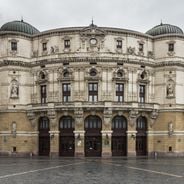
Bilbao combines contemporary art with Gothic architecture and offers visitors insight into Basque culture and history. The Guggenheim Museum draws art enthusiasts from around the world with its sculptural titanium facade, while the Fine Arts Museum houses a significant collection of classical and modern works. The Mercado de la Ribera, an Art Nouveau structure on the riverfront, is Europe's largest covered market and showcases the region's culinary traditions. The old quarter clusters around the Gothic Cathedral of St. James and Plaza Nueva, whose 19th-century arcades shelter bars and restaurants. Along the Nervión, historic bridges like Arenal Bridge and modern structures like Zubizuri Bridge connect both riverbanks. The Begoña Basilica sits above the city and provides views across the rooftops and hills. The Arriaga Theatre and Euskalduna Palace represent different architectural periods, while Azkuna Zentroa repurposes an early 20th-century wine warehouse as a cultural center. The Artxanda funicular railway enables panoramic views across the entire urban area and surrounding mountains.

Exceptional high rise architecture: modern skyscrapers, innovative buildings

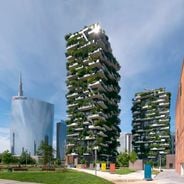
This collection brings together high rises and structures from different continents that redefine conventional building standards through their exceptional architecture. From the spiral rotation of Turning Torso in Malmö to the distinctive form of the CCTV Headquarters in Beijing, these buildings showcase innovative approaches to construction and design. The selection includes Burj Khalifa in Dubai, currently the world's tallest building at 2,717 feet (828 meters), as well as Marina Bay Sands in Singapore with its distinctive rooftop terrace. The collection also presents cultural facilities such as the Guggenheim Museum Bilbao by Frank Gehry with its sculptural titanium facades and the Walt Disney Concert Hall in Los Angeles. Additional examples are the Absolute World Towers in Mississauga, known as the Marilyn Monroe Towers for their twisted structure, as well as Shanghai Tower, which rises 2,073 feet (632 meters). The Guangzhou Opera House and the Helix Bridge in Singapore demonstrate the diversity of contemporary architectural solutions. Each of these structures combines technical innovation with architectural vision and shapes its city's skyline. From historic skyscrapers like the Empire State Building to modern developments like Bosco Verticale in Milan with its planted facades, this selection offers insights into the evolution of high rise construction worldwide.

Frank Gehry buildings

Frank Gehry designs buildings with curved metal facades, irregular forms and experimental construction methods. His work defines urban spaces from Bilbao to Los Angeles. The exterior surfaces use titanium, steel or glass formed into wave-like or folded volumes. The interior spaces accommodate art collections, concert halls and commercial offices. The Guggenheim Museum in Bilbao displays titanium panels that reflect the light of the Basque coast. The Walt Disney Concert Hall in Los Angeles combines stainless steel surfaces with wooden acoustics for the Los Angeles Philharmonic. The Vitra Design Museum in Weil am Rhein demonstrates his early approaches with white stucco surfaces and angled walls. The buildings emerge through computer-aided design that translates complex geometries into buildable structures.

Reviews

Visited this place? Tap the stars to rate it and share your experience / photos with the community! Try now! You can cancel it anytime.

« Guggenheim Museum - Contemporary art museum in Abando district, Bilbao, Spain » is provided by Around Us (aroundus.com). Images and texts are derived from Wikimedia project under a Creative Commons license. You are allowed to copy, distribute, and modify copies of this page, under the conditions set by the license, as long as this note is clearly visible.

Discover hidden gems everywhere you go!

From secret cafés to breathtaking viewpoints, skip the crowded tourist spots and find places that match your style. Our app makes it easy with voice search, smart filtering, route optimization, and insider tips from travelers worldwide. Download now for the complete mobile experience.
Around Us App Screenshot

A unique approach to discovering new places

Le Figaro

All the places worth exploring

France Info

A tailor-made excursion in just a few clicks

20 Minutes