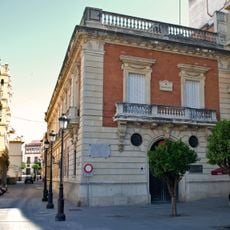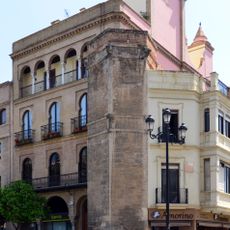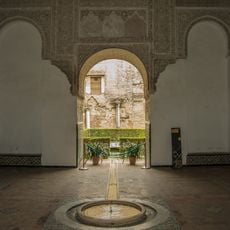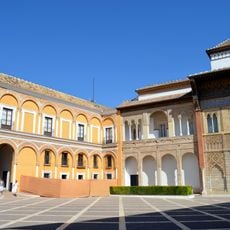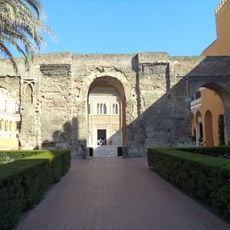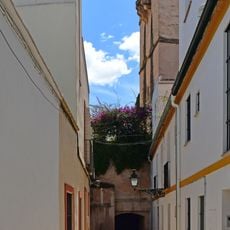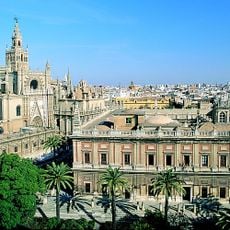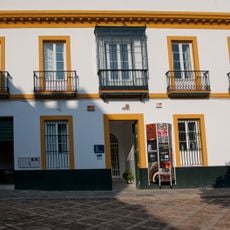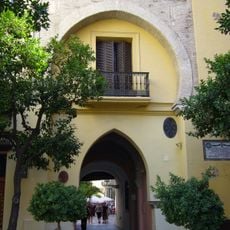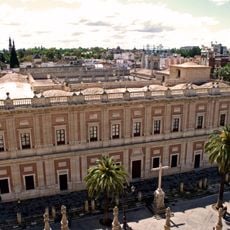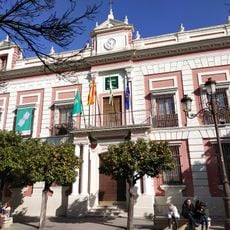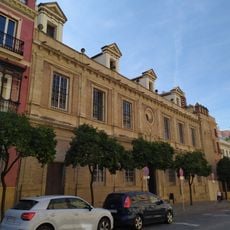
Palacio del Rey don Pedro, Mudejar palace in Patio de la Montería, Seville, Spain.
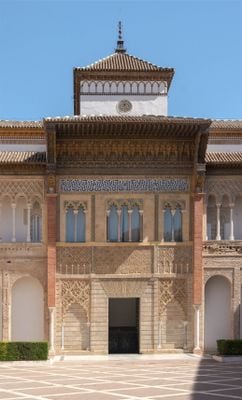
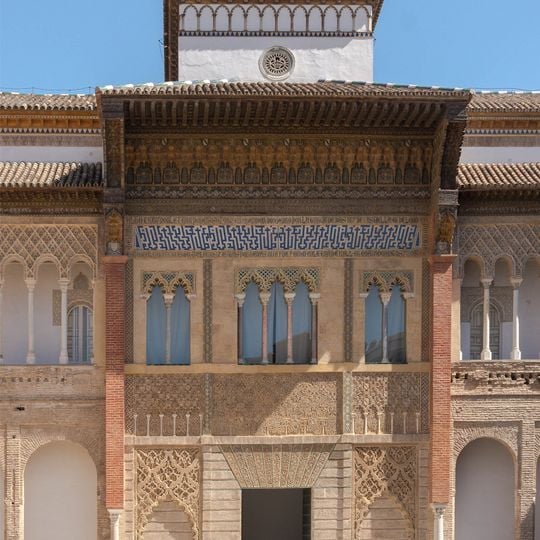
The Palacio del Rey don Pedro is a Mudejar palace built between 1356 and 1366. Its main facade, on the Patio de la Montería, has a wide wooden eave with gilded muqarnas brackets, a band of blue-and-white geometric tile with the Nasrid motto "wa lā ghālib illā Allāh" in Kufic script, and a Gothic inscription naming Pedro I. The rectangular doorway has a stone lintel with fine alaurique carving, flanked by lobed arches with sebka and marble columns.
Pedro I had this palace built between 1356 and 1366 next to Alfonso X's Gothic palace, using craftsmen from Toledo, Granada and Seville. It was later altered under the Catholic Monarchs and the early Habsburgs. The upper floor of the Courtyard of the Maidens was rebuilt between 1540 and 1572 with marble columns carved in Genoa.
The rooms bear names like the Hall of Ambassadors, marking their original purpose in royal ceremonies and governance. Visitors notice how Arabic inscriptions appear alongside Castilian text throughout the decorated chambers, revealing the cultural exchange that shaped the residence.
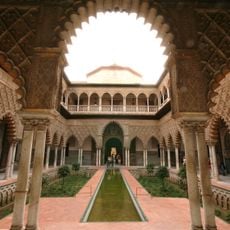
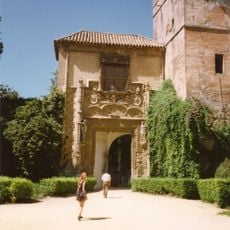
The main entrance is through the Puerta del León into the Real Alcázar; the palace itself is entered from the Patio de la Montería. The Patio de las Doncellas measures 21 by 15 metres, with two galleries of seven arches and two of five. The sunken beds and pool were buried under marble flooring from 1580 to 1584 and uncovered again in 2002.
The pool and sunken beds of the Patio de las Doncellas were buried under marble paving between 1580 and 1584, laid by craftsmen from Macael, Espera and Acán. Archaeologists uncovered the beds and pool again in 2002, restoring the courtyard's original 21 by 15 metre layout.
The community of curious travelers
AroundUs brings together thousands of curated places, local tips, and hidden gems, enriched daily by 93,897 contributors worldwide.