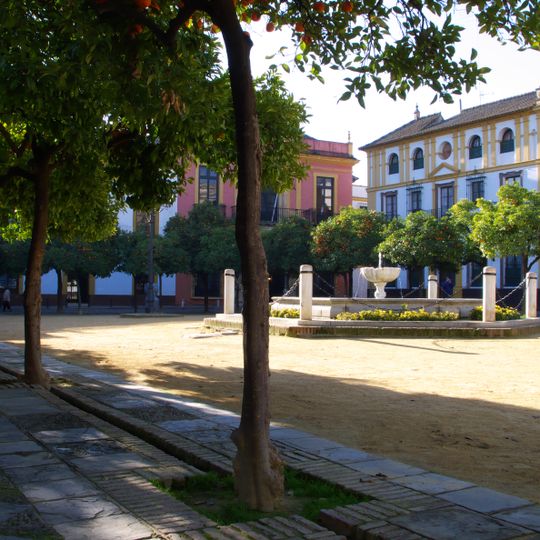
Patio de Banderas, Royal courtyard at Alcazar complex, Seville, Spain
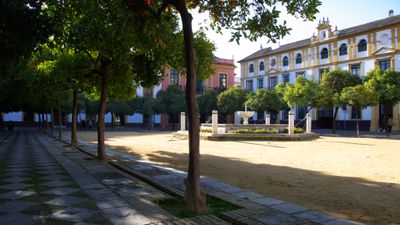
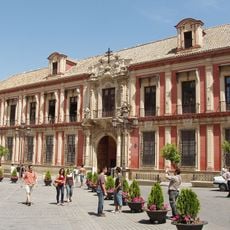
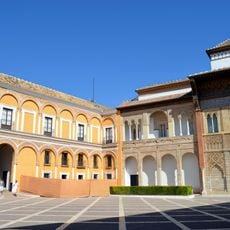
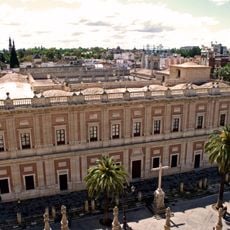
The Patio de Banderas is a rectangular courtyard within the Alcázar complex featuring two rows of orange trees and a central hexagonal fountain. The space is surrounded by palace buildings on all sides, creating an enclosed plaza with paved ground.
The courtyard was designed as an entrance area for the Alcázar and evolved into a key connecting point within the complex. Archaeological excavations between 2008 and 2009 revealed settlement evidence beneath the surface dating back to the seventh century BC.
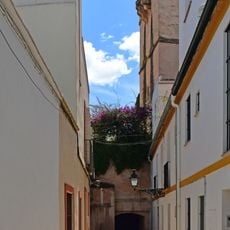
Visitors walking through notice the orange trees and the open arrangement that creates a sense of transition between the palace and the surrounding city. The space functions as a threshold where people pass between two distinct neighborhoods.
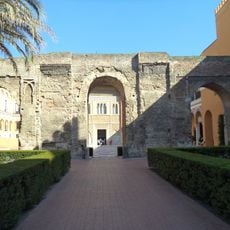
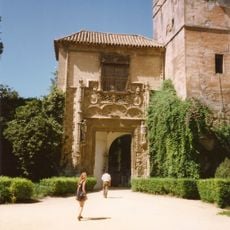
The courtyard is accessible through an arched passage from the Alcázar and connects the palace directly to the adjacent Jewish quarter. Visitors should note that the smooth stone surface can be slippery when wet.
The name comes from painted flags that once decorated the entrance arch, a detail documented by writer Fernán Caballero in her work about the Alcázar. This historical marking is no longer visible today, yet the name still recalls this original decoration.
Location: Seville
GPS coordinates: 37.38490,-5.99134
Latest update: December 6, 2025 17:41
Seville reveals its story through the marks of many years. The Cathedral and its Giralda tower show the change from Gothic to baroque. The Royal Alcázar mixes Islamic designs with gardens shaded by orange trees. Walking through the streets, you move from the narrow alleys of Santa Cruz to the open views of Plaza de España, built in the early 20th century with channels and colorful tiles. Maria Luisa Park gives a break under the Mediterranean trees, not far from the Metropol Parasol with its modern wooden shapes that stand out against the old buildings. Along the Guadalquivir River, the Torre del Oro hints at how important the river was in medieval times. The Triana Bridge connects the city center to the pottery and sailor neighborhoods. Places like the Fine Arts Museum and the Hospital de los Venerables open doors to spaces where art and architecture meet. Each spot tells a different part of the story, with no one dominating.
Seville Cathedral
182 m
Reales Alcázares
54 m
Giralda
166 m
Tomb of Christopher Columbus
164 m
General Archive of the Indies
155 m
Giraldillo
179 m
Courtyard of the Orange Trees, Cathedral of Seville
233 m
Palacio del Rey don Pedro
104 m
Archbishop's Palace
227 m
Gardens of the Royal Alcázar of Seville
188 m
Torre de Abdelazis
220 m
Room of Justice, Alcázar of Seville
79 m
Casa de Murillo
219 m
Patio de la Montería
112 m
Patio del León, Alcázar of Seville
89 m
Postigo de la Torre del Agua
130 m
Monumento a Juan Pablo II (Sevilla)
138 m
Cathedral, Alcázar and Archivo de Indias in Seville
120 m
Chapel of Saint Gregory, Cathedral of Seville
217 m
Foro de la Biodiversidad (Sevilla)
42 m
Arco de la Plata o de Mañara
218 m
Antigua Casa Lonja
151 m
Palacio de la Diputación Provincial
61 m
Edificio actual de la Oficina de Turismo
224 m
Cilla del Cabildo
142 m
Instituto Andaluz de Arquitectura
28 m
Casa unifamiliar, actual Consulado de Francia.
232 m
Portal of Marchena, Alcázar of Seville
140 mReviews
Visited this place? Tap the stars to rate it and share your experience / photos with the community! Try now! You can cancel it anytime.
Discover hidden gems everywhere you go!
From secret cafés to breathtaking viewpoints, skip the crowded tourist spots and find places that match your style. Our app makes it easy with voice search, smart filtering, route optimization, and insider tips from travelers worldwide. Download now for the complete mobile experience.
A unique approach to discovering new places❞
— Le Figaro
All the places worth exploring❞
— France Info
A tailor-made excursion in just a few clicks❞
— 20 Minutes