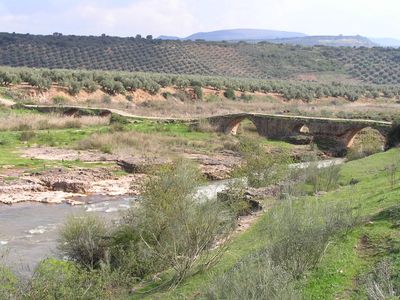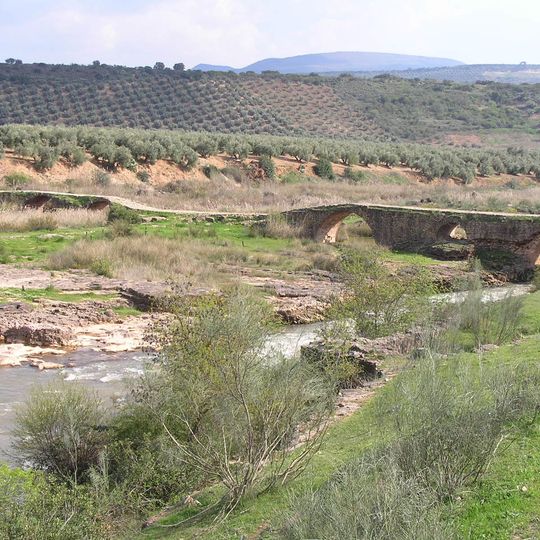
Puente Mocho, Roman bridge over Guadalimar River between Beas de Segura and Chiclana de Segura, Spain
Puente Mocho is a stone bridge spanning the Guadalimar River between two towns, consisting of six arches that together cross approximately 100 meters of water. Its consistent width of about 4.5 meters throughout demonstrates stable construction and reflects proven Roman building methods.
The site was already used in the Lower Paleolithic, when the river served as a watering place for animals and a hunting ground. In the Bronze Age it became a crossing point for the extraction and trade of minerals from Sierra Morena. The Romans repaired the roads and built the bridge; it carried a secondary route, the "Camino de los Cartagineses", coming from the Sierra de Segura through Camporredondo and El Campillo and joining the "vereda real" near Santisteban, still used for transhumance.
The bridge displays Roman building methods through its carefully arranged stone blocks and vault design that were standard in this region during the Imperial period. Visitors can still observe the craftsmanship that went into constructing river crossings in antiquity.
The best way to explore the bridge is to walk along its sides to examine its structure and arches at your own pace. Visiting during drier months is advisable so you can observe river conditions and find safe access routes.
At the bridge location, significant traces from the Lower Paleolithic period were discovered, ranking among the oldest known findings of the southern region. These archaeological discoveries show that people used this area long before Roman times.
The community of curious travelers
AroundUs brings together thousands of curated places, local tips, and hidden gems, enriched daily by 95,298 contributors worldwide.