The Caryatids Building, Language and cultural institution in central Madrid, Spain
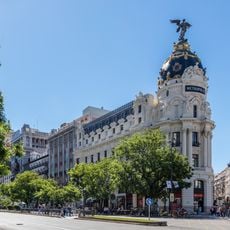
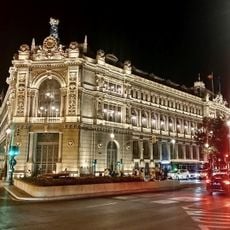
The Instituto Cervantes occupies the Edificio de las Cariátides, a chamfered building at 49 Calle de Alcalá, on the corner with Calle Barquillo. Designed by Antonio Palacios and Joaquín Otamendi and opened in 1918, it has a monumental eclectic style with Greek Neoclassical elements. Two large female-figure columns, caryatids, flank the main entrance.
The institute was founded in 1991 and named after Miguel de Cervantes, the celebrated author of Don Quixote. Its creation was part of Spain's effort to promote the Spanish language and literature around the world.
The building's popular name comes from the two female-figure columns flanking the main entrance on Alcalá street. Since October 2006 it has housed the Instituto Cervantes, whose emblem by Enric Satué was placed between the caryatids; it was inaugurated on 12 October 2006 by King Juan Carlos I and Queen Sofía. The remodelled interior holds exhibition halls and an auditorium for 1,200 people.
The building stands at the corner of Calle de Alcalá 49 and Calle Barquillo, a short walk from Puerta del Sol and next to the Palacio de Buenavista. The Instituto Cervantes occupies it as offices and exhibition halls, with an auditorium for 1,200 people; the caryatids flank the main entrance on Alcalá. Its second headquarters, used for teacher training, is in the Colegio del Rey in Alcalá de Henares.
The two caryatids flanking the main entrance on Alcalá street gave the building its popular name; officially it is the Cervantes Building. The Instituto Cervantes logo by Enric Satué was placed between them in October 2006, when King Juan Carlos I and Queen Sofía inaugurated the headquarters.
The community of curious travelers
AroundUs brings together thousands of curated places, local tips, and hidden gems, enriched daily by 94,135 contributors worldwide.