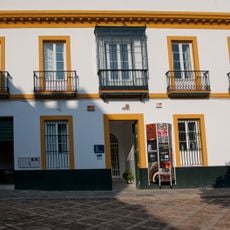
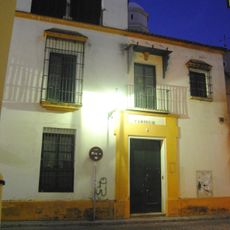
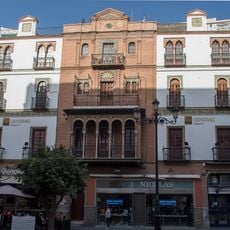
Casa de los Pinelo, Renaissance palace in Santa Cruz district, Seville, Spain
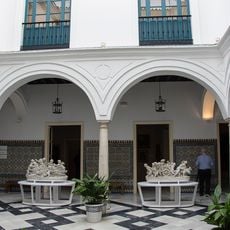
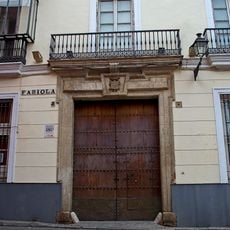
Casa de los Pinelo is a Renaissance-era house-palace in Seville's historic centre, now home to the Real Academia Sevillana de Buenas Letras and the Real Academia de Bellas Artes de Santa Isabel de Hungría. Its plain stone facade has a slate-covered balcony on the first floor and a mirador with marble columns and openwork Gothic tracery on the second. Inside, a courtyard has arcades on three sides, built on Carrara marble columns carved in Genoa around 1540, with Plateresque plasterwork and carved heads inspired by Jorge de Montemayor's 1542 pastoral novel Los siete libros de Diana.
Construction began in the early 16th century under Jerónimo Pinelo, a canon of Seville Cathedral and son of Francisco Pinelo, a Genoese banker who helped finance Columbus's first voyage. After Jerónimo's death the house passed, in the second half of the 16th century, to the cathedral chapter, which used it as housing for clergy until the 1855 disentailment decree. It was auctioned in 1856 for 118,560 reales de vellón, served as a school, horse-rental business, type foundry and from 1885 a hostel, and was declared a National Monument on 5 February 1954.
The arches of the main courtyard rest on Carrara marble columns carved in Genoa around 1540, and their spandrels carry heads inspired by Jorge de Montemayor's pastoral novel Los siete libros de Diana (1542), which describes a temple of Diana with a courtyard of ancient, medieval and Renaissance figures. The arcades are covered with Plateresque plasterwork.
The building sits on Calle Abades in the heart of the old city center and is easy to reach on foot. Keep in mind that access to the inner courtyards and rooms may be limited, so it helps to check ahead which areas are open to visitors.
The arches' spandrels carry carved heads inspired by Jorge de Montemayor's pastoral novel Los siete libros de Diana (1542), which describes a temple to Diana with a courtyard of ancient, medieval and Renaissance figures. The Carrara marble columns were worked in Genoa around 1540.
The community of curious travelers
AroundUs brings together thousands of curated places, local tips, and hidden gems, enriched daily by 94,786 contributors worldwide.