Castillo de Salvatierra, Medieval fortress in Calzada de Calatrava, Spain.
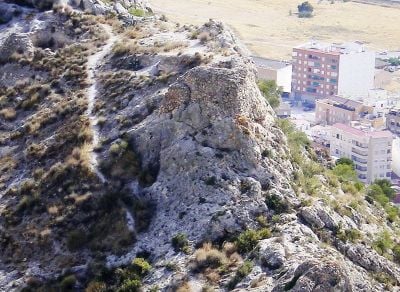
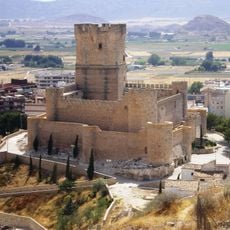
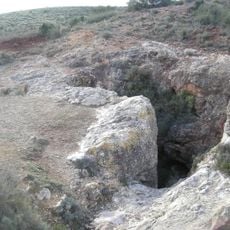
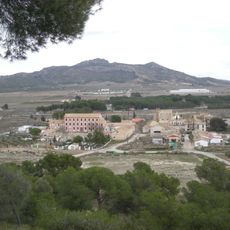
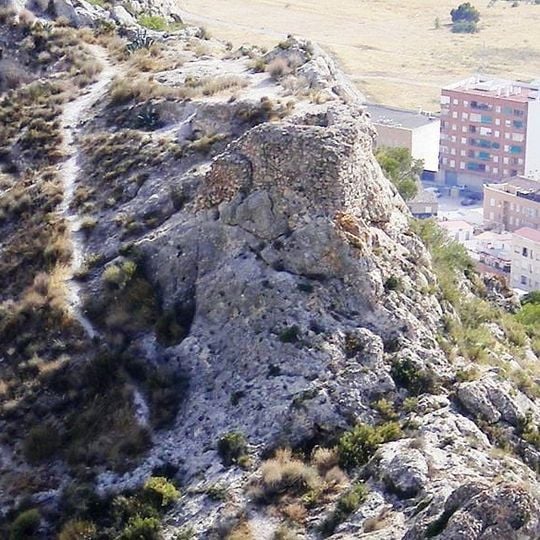
Castillo de Salvatierra, known as El Castillico, is a ruined rectangular fortress on a fold of the Sierra de la Villa above Villena. It measures 50 m long and 5 m wide, with double-faced walls 60 cm thick of medium stones set in mortar. Three towers stand at its upper end; the square southern keep has walls up to 3 m thick, two lower bodies of Almohad rammed earth and a Mancala board carved into the rock.
Built in the 10th century, the fortress was Islamic in origin, from the caliphal period, and lasted through the Almohad era until its abandonment in the 14th century in favour of the Castillo de la Atalaya. Its first historical mention dates from the 13th century, when it was pledged as dowry for the marriage of Don Juan Manuel, Lord of Villena, to the infanta Isabel of Mallorca. José María Soler's 1951 excavations confirmed occupation also in prehistoric and ancient times.
The castle is popularly known as El Castillico. In the south tower, the Torre del Homenaje, a mancala board of Muslim origin is still carved into the rock, a pastime left by the site's inhabitants. The fortress is divided into an upper alcazaba and a lower albacara, and water was collected in a cistern and channels cut into the rock.
The fortress is accessed via the road de la Bodega, which connects to camino del Castillo and leads directly to the southern side of the structure. Visitors should explore the site in daylight and be prepared for uneven terrain, as the ruins lack modern facilities.
In the south tower, the keep, a mancala board is carved into the rock: a game of Muslim origin that survives on the masonry. The keep has four sections, the first two in Almohad rammed earth, and walls up to three metres thick.
The community of curious travelers
AroundUs brings together thousands of curated places, local tips, and hidden gems, enriched daily by 95,652 contributors worldwide.