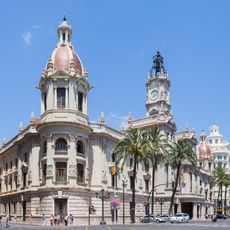
Convento de San Francisco, Franciscan friary near Plaza del Ayuntamiento, Valencia, Spain.
Convento de San Francisco was a Franciscan friary whose grounds covered almost the entire site of today's Plaça de l'Ajuntament in Valencia. Its church, rebuilt in the Gothic style in 1366 by Berenguer Codinats, had a single nave with side chapels between buttresses, a polygonal apse and ribbed vaults. Two large two-storey Gothic cloisters stood within the complex, one decorated with paintings of the life of Saint Francis.
Founded in 1238 by King James I of Aragon, the friary originally stood outside the city walls near Valencia's Boatella Gate. The complex lasted for over 650 years until its complete demolition in 1891 to make way for today's town square.
The friary church held the tomb of Berenguer Codinats, who financed its 14th-century rebuild, and the remains of King Abu Zayt, the Muslim ruler baptised as Vicent Bellvís. A painting of the Eucharistic Saviour by Juan de Juanes is now in the Museu de Belles Arts de València.
The friary no longer stands; its footprint is covered by the Plaza del Ayuntamiento, bounded by Calle San Vicente, Avenida María Cristina and Calle Barcelonina. The site lies between the Estación del Norte and the city hall, and the surrounding streets are pedestrianized. The former orchard and cemetery occupied the ground behind the convent, where the Telefónica and La Equitativa buildings now stand.
According to legend, two Franciscan monks from Teruel reportedly prophesied to Muslim ruler Abu Zeyt the imminent fall of his kingdom. This story connects the friary walls to Valencia's turbulent religious and political past.
The community of curious travelers
AroundUs brings together thousands of curated places, local tips, and hidden gems, enriched daily by 94,332 contributors worldwide.