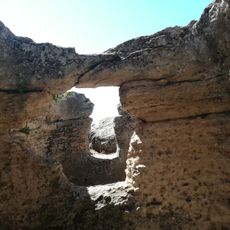
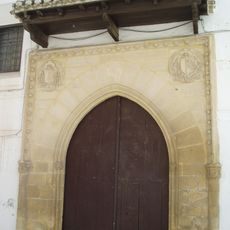
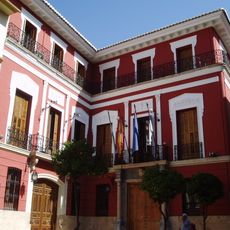
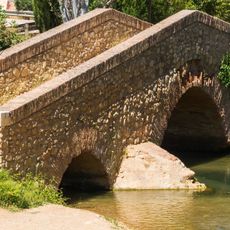
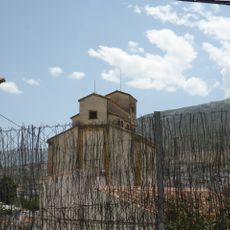
Castillo, Medieval fortress in Iznájar, Spain.
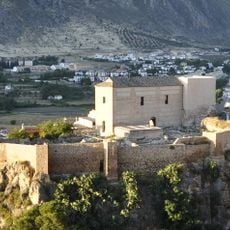
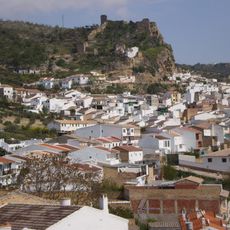
Castillo (Iznájar) is a medieval fortress with a triangular layout featuring defensive towers positioned at its corners and standing at the highest elevation within the old town quarter. The structure was strategically sited to dominate and protect the settlement below.
The castle is first documented in the 8th century, after the Muslim conquest, though some historians propose 726 or 742 and others argue for a pre-Muslim origin. It took part in Omar ibn Hafsún's revolt against the Caliphate of Córdoba, after which Abd al-Rahman III rebuilt it intensively. Pedro I took it in 1362, but it returned to Nasrid rule under Muhammad V four years later; Pedro Fernández de Córdoba conquered it definitively in 1434.
The name comes from the Arabic hisn al-ashar, "the joyful castle", and gave the town of Iznájar its name. In the Nasrid kingdom, a hisn was a frontier administrative unit centred on a fortress built on high ground, from which the settlement was organised. The historian al-Idrisi described the town as having a well-fortified castle, a large population and a famous alcaicería, the silk market.
The castle stands at the highest point of Iznájar, reached on foot through the streets of the old town, so expect steep slopes and stairs. The site was restored in 2007 and opened for tourist visits. The inner walled enclosure has a perimeter of 98 metres, and the entrance door opens directly onto the parade ground.
The castle's name comes from the Arabic hisn al-ashar, "the joyful castle", and the term hisn also designated a frontier villa of the Nasrid kingdom, an administrative unit centred on a fortress built on high ground. The keep is one of four towers, alongside the tower attached to the primitive body, the pentagonal prow tower and the southeast tower.
The community of curious travelers
AroundUs brings together thousands of curated places, local tips, and hidden gems, enriched daily by 94,769 contributors worldwide.